

Here’s something most people don’t know: the stone sitting in museums across Europe, carved with the face of Christ, wasn’t gold or ruby. It was bloodstone. Used by ancient warriors, Roman magicians, medieval healers, and now crystal enthusiasts across Canada, bloodstone is one of the most misunderstood gemstones on earth. And once you understand what it truly is, you’ll never look at a dark green crystal the same way again.
What Is Bloodstone?
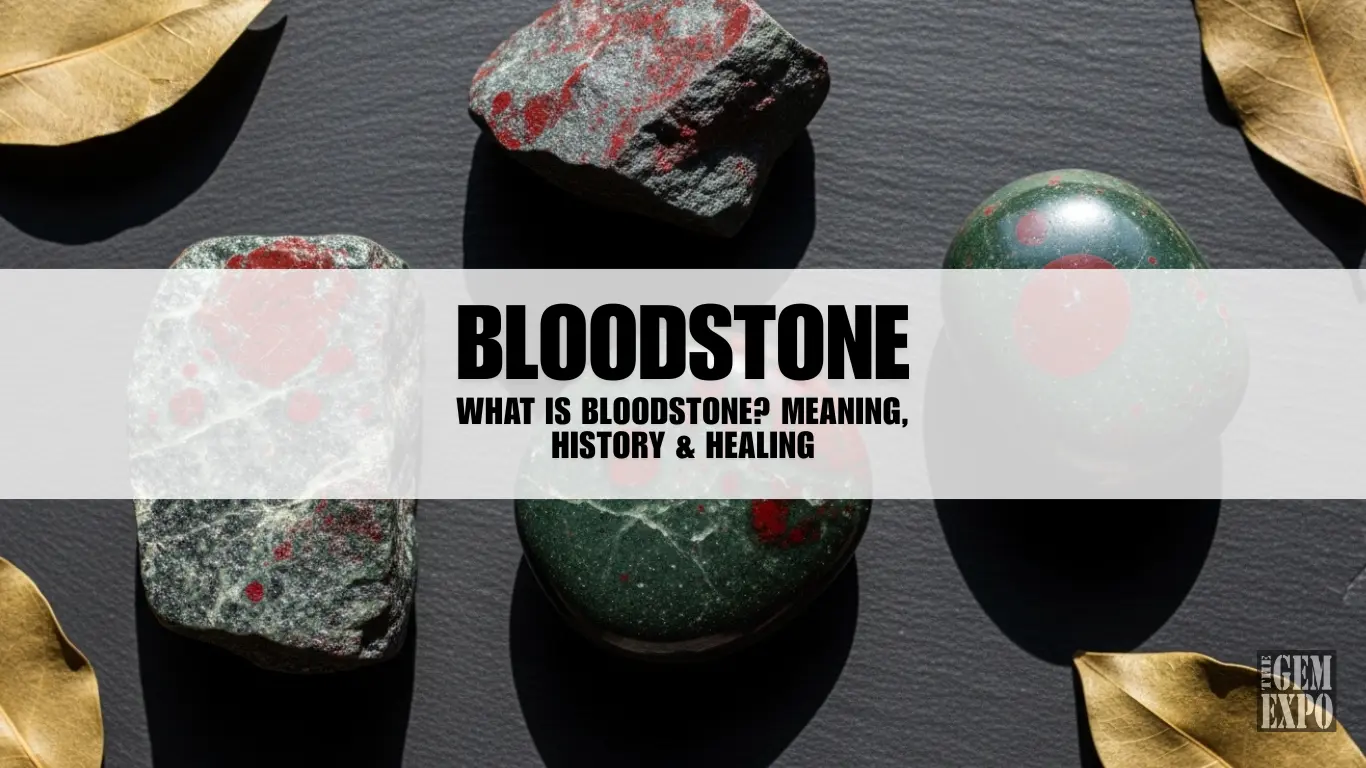
Bloodstone, also known as heliotrope, is a variety of chalcedony quartz characterised by its deep forest-green base colour speckled with vivid crimson-red spots. Those red flecks are caused by iron oxide inclusions, while the green matrix comes from chlorite or hornblende within the stone. The result is a gemstone that looks almost alive, like something fierce and ancient is coursing through it.
Geologically, bloodstone sits at around 6.5–7 on the Mohs hardness scale, making it durable enough for everyday jewellery and carving. It is primarily sourced from India, with additional deposits found in Australia, Brazil, China, and Scotland. When polished, it takes on a naturally waxy lustre that collectors and crystal lovers find striking.
Unlike synthetic or dyed stones, authentic bloodstone is rarely enhanced. What you see is exactly what the Earth made. At The Gem Expo, Canada’s largest gem and mineral show, held three times a year at the Hyatt Regency in downtown Toronto, you’ll find genuine bloodstone pieces sourced directly from trusted vendors and verified collectors.
The Ancient History of Bloodstone
Few gemstones carry a history as rich and dramatic as bloodstone. Its story stretches back thousands of years across multiple civilisations, each one finding its own meaning in its distinctive appearance.
Ancient Greece & Rome
The ancient Greeks called it Heliotrope, meaning “sun-turner”. Believing that when submerged in water, the stone would turn the reflection of the sun blood-red. Roman soldiers wore bloodstone amulets during athletic competitions and battle, convinced it boosted endurance, strength, and physical vitality. Roman historian Pliny the Elder wrote that the sun itself could be seen in bloodstones, as in a mirror.
The Christian Legend
One of the most enduring stories surrounding bloodstone comes from Christian tradition. According to legend, bloodstone was originally pure green jasper that had formed at the foot of the cross during the crucifixion of Jesus Christ. When drops of His blood fell onto the stone, they became permanently embedded, giving the gem its name and sacred significance. Medieval Christian artists carved bloodstone into religious icons, intentionally positioning the red spots to represent wounds. Many of these extraordinary pieces are preserved in museums across Europe today.
Middle Ages to Modern Day
In the Middle Ages, bloodstone was carried as a powerful protective talisman believed to stop bleeding and ward off illness. It was also thought to be a stone of prophecy, giving its bearer audible guidance in times of crisis. As crystal healing traditions grew across the 20th century, bloodstone reclaimed its place as one of the most widely used healing stones in the world.
Bloodstone Healing Properties
Bloodstone‘s healing reputation is built on centuries of tradition and is centred around three core areas: physical vitality, emotional strength, and spiritual grounding.
Physical Healing
Traditionally associated with the circulatory system, bloodstone is believed to support healthy blood flow, strengthen the heart, and assist the body’s natural detoxification through the liver, kidneys, and spleen, much like how complementary stones such as Apatite work alongside the body’s natural systems. It has long been recommended as a stone for immune system support and is particularly noted for its connection to blood-related health. Many practitioners who explore Apatite’s meaning and its 7 healing properties often discover that pairing it with bloodstone creates a powerfully balanced approach to physical wellness, one stone energising the circulatory system while the other supports metabolism and cellular renewal. Beyond that synergy, bloodstone continues to stand on its own: practitioners regularly use it to support bone marrow health, increase physical energy, and build long-term stamina. If you’re drawn to stones with deep physical healing traditions, learning how to use Apatite alongside bloodstone is a natural next step in your crystal wellness journey.
Emotional & Mental Healing
On an emotional level, bloodstone‘s meaning is deeply tied to courage, resilience, and calm decision-making under pressure. It is recommended as a supportive stone for those processing PTSD, grief, anxiety, or emotional overwhelm. Rather than numbing difficult feelings, bloodstone encourages you to move through them, to face what is hard, act with clarity, and then tend to your own wellbeing. It eases irritability, impatience, and fear while fostering self-confidence and independence.
Spiritual Healing
Spiritually, bloodstone is considered a stone of the warrior, not in a combative sense, but in the sense of someone who leads with integrity, sacrifices for others, and takes responsibility. It grounds spiritual calling into practical, everyday action, making it one of the most grounded yet deeply purposeful stones in the crystal world. For those who are also drawn to the amethyst crystal meaning and its benefits for higher consciousness, the pairing with bloodstone becomes especially powerful: where amethyst lifts your awareness toward intuition and calm, bloodstone anchors that spiritual insight into real-world courage and decisive living. Together, they cover the full spectrum, from inner reflection to outer strength. If you’re exploring the spiritual power of healing stones beyond the surface level, understanding how bloodstone and amethyst complement each other through their uses is a journey worth taking.
Bloodstone & the Chakras
Bloodstone works primarily with two chakras, making it a uniquely grounding yet heart-centred stone:
| Chakra | Bloodstone’s Role | Benefit You’ll Notice |
| Root Chakra (Muladhara) | Primary activation | Grounding, stability, sense of safety and security |
| Heart Chakra (Anahata) | Secondary healing | Emotional resilience, compassion, release of grief |
By stimulating the root chakra, bloodstone anchors scattered energy, promotes a sense of security, and helps you stay present. Its connection to the heart chakra then channels that grounded strength into compassion and emotional healing.
Bloodstone as a Birthstone & Zodiac Stone
Bloodstone is the traditional birthstone for March, making it a meaningful gift for Canadians born during the late winter and early spring months. It is the stone most associated with Aries (March 21–April 19) and also resonates strongly with Pisces (February 19–March 20), offering grounding energy to balance Pisces‘ imaginative, sometimes scattered nature.
For those born under Aries, bloodstone amplifies natural leadership qualities while softening impulsivity. It teaches that true courage isn’t the absence of fear, it’s moving forward anyway.
How to Use Bloodstone
One of bloodstone’s greatest strengths is its versatility. Here are the most popular ways Canadians are working with bloodstone today:
- Jewellery: Wear a bloodstone bracelet over your pulse point, a pendant near your heart, or a ring to keep its energy flowing throughout the day.
- Meditation: Hold bloodstones in your left hand during meditation, focusing on root chakra activation, and visualise a deep crimson-red light anchoring you to the earth.
- Home & Office: Place bloodstones near your workspace to encourage grounded focus and protect against negative energy.
- Crystal Pairing: Bloodstone works beautifully alongside amethyst for emotional healing, lapis lazuli for intuitive clarity, and black obsidian for deep protective work.
How to Cleanse & Care for Your Bloodstones
To keep your bloodstone working at its full potential, regular cleansing is recommended, and the same mindful care applies to many healing stones, including aragonite crystal, where proper maintenance directly affects how the stone performs energetically. Run bloodstone under cool or tepid water for 1–2 minutes to clear absorbed energies; this method is rooted in both intuitive practice and the real science behind how porous minerals interact with environmental charge over time. For a deeper cleanse, bury it in the earth overnight or place it on a bed of Himalayan salt, two of the most traditional and effective methods used by crystal practitioners across Canada. Avoid prolonged sunlight exposure, as it can fade some varieties over time, a care rule equally important when you explore aragonite crystal care, since many calcium-based stones are similarly sensitive to heat and UV light. Finally, recharge your bloodstone under moonlight, particularly during a full moon, to restore its natural vitality. Understanding the meaning behind each cleansing method, not just the mechanics, transforms routine crystal care into a genuinely intentional practice.
FAQs
Can bloodstone be worn every day, or is it too powerful for daily use?
Yes, bloodstone is one of the few healing crystals considered safe and beneficial for daily wear. Its grounding energy is steady rather than overwhelming, making it ideal for bracelets, rings, or pendants worn throughout the day. However, if you're going through a period of intense emotional processing, limit wear to a few hours and cleanse it nightly.
Is bloodstone the same as red jasper?
No, though they are often confused. Bloodstone is a dark green chalcedony with red iron oxide spots, whereas red jasper is a fully opaque, solid red stone. Some bloodstone formations do contain red jasper inclusions within the green matrix, which is where the confusion arises. They are separate stones with distinct energetic properties, though they complement each other well when used together.
How do I know if my bloodstone is real or fake?
Authentic bloodstone will feel cool and heavy in the hand, with natural, never perfectly round or uniform, red spots. Hold it up to light: genuine bloodstone has a waxy, slightly translucent quality. Fakes are often dyed green agate with painted red dots that look too symmetrical. When in doubt, purchase from verified vendors, like those at The Gem Expo. who source directly and can authenticate their stones.
Can bloodstone go in water for cleansing?
Yes, bloodstone is water-safe due to its hardness rating of 6.5–7 on the Mohs scale. Running it under cool or tepid water for 1–2 minutes is one of the most recommended cleansing methods. Avoid saltwater or prolonged soaking however, as extended exposure can dull its natural waxy lustre over time.
What is the difference between bloodstone and heliotrope, are they the same stone?
Yes and no. Heliotrope is the geological and historical name for bloodstone, derived from the Greek meaning "sun-turner." However, some gemologists make a subtle distinction: heliotrope refers specifically to translucent specimens with clearly defined red spots, while bloodstone is used more broadly to include opaque varieties. In everyday crystal healing and jewellery contexts across Canada, the two names are used interchangeably.
Discover Bloodstone at The Gem Expo
If you’re looking to experience bloodstone in person, to hold it, feel its weight, and choose a piece that truly calls to you. The Gem Expo is the perfect place to start. As Toronto’s only gem, mineral, fossils, bead, and jewellery show, The Gem Expo runs three times a year at the Hyatt Regency in downtown Toronto, bringing together Canada’s most trusted vendors, collectors, and artisans under one roof.
Whether you’re drawn to a raw tumbled bloodstones for your meditation practice, a hand-crafted sterling silver bloodstones pendant, or a collector-grade specimen, you’ll find it, and the expertise to go with it, at The Gem Expo.
Visit The Gem Expo to explore upcoming show dates and get your tickets.