

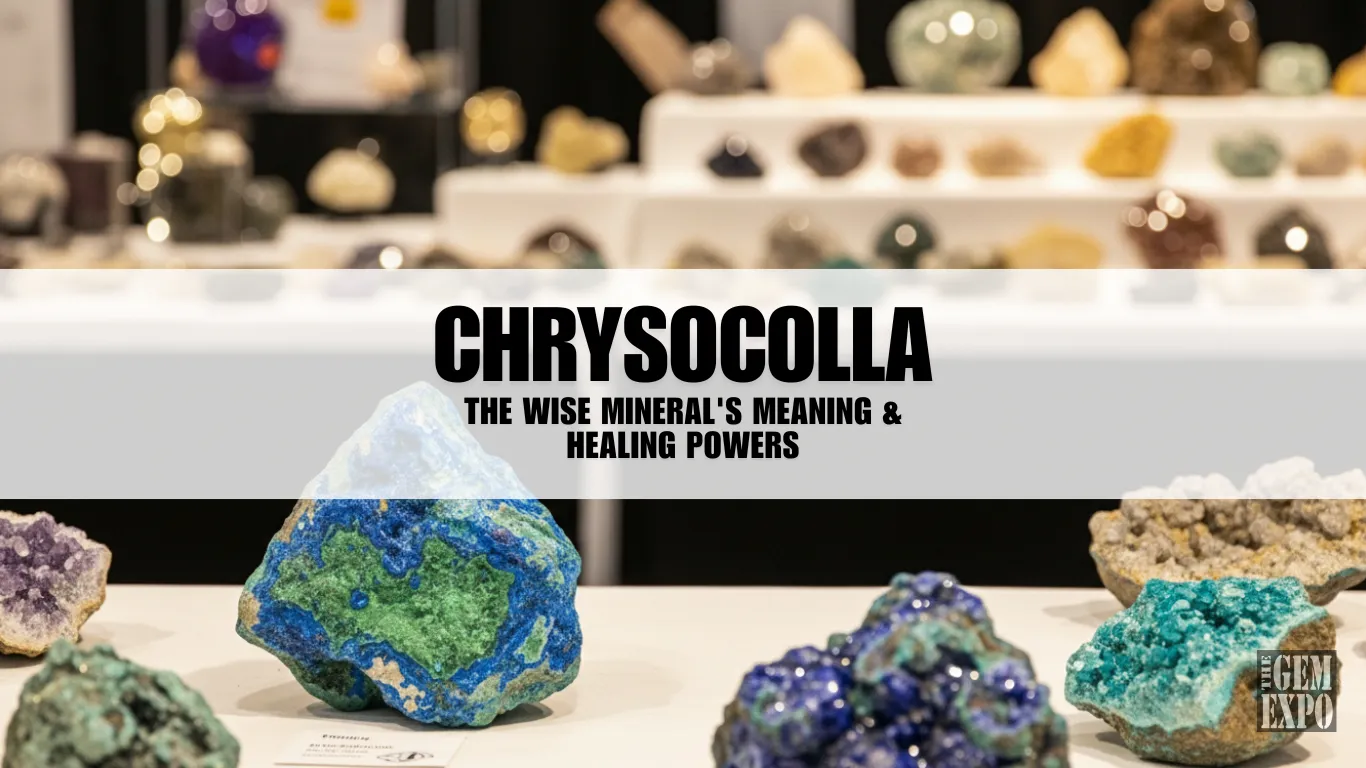

Ancient Egyptians called it the stone of wisdom. Greek goldsmiths relied on it to bind gold. Cleopatra reportedly carried it through every political negotiation she ever entered. Today, thousands of crystal collectors and spiritual seekers across Canada seek out chrysocolla for the very same reason people have treasured it for over two thousand years. It’s quiet, grounding power to help you speak your truth, heal your heart, and face change without fear. So what exactly makes this blue-green mineral so enduring, and how can you put it to work in your own life?
What Is Chrysocolla?
Chrysocolla is a copper-bearing mineral that naturally forms wherever copper deposits exist in the earth. Its name draws directly from ancient Greek: chrysos (gold) and kolla (glue), because Greek craftsmen originally used it as a soldering agent as far back as 315 BCE. Over the centuries, however, what began as a practical workshop material gradually earned a far richer identity as one of the most spiritually significant minerals in human history.
Visually, chrysocolla ranges from bright sky blue to deep forest green, often laced with earthy brown or white from surrounding quartz and malachite. Every piece looks completely different. No two specimens ever share the same pattern, which is part of what makes collecting them so deeply satisfying.
Because it forms alongside minerals like azurite, malachite, turquoise, and cuprite, people frequently confuse it with turquoise. The table below clarifies the key differences at a glance:
| Feature | Chrysocolla | Turquoise |
|---|---|---|
| Primary Colour | Blue-green (copper-rich) | Blue-green (with matrix) |
| Composition | Copper hydroxy silicate | Copper aluminium phosphate |
| Hardness | 2.5 to 3.5 (Mohs) | 5 to 6 (Mohs) |
| Origin | Found near copper mines | Found in arid, alkaline soils |
| Common Uses | Jewellery, meditation, décor | Jewellery, cultural artefacts |
| Spiritual Focus | Communication, teaching | Protection, good fortune |
A Mineral With a 2,000-Year Story
Here is something that genuinely surprises most people: chrysocolla was not always prized for its beauty. For most of its early history, craftsmen valued it purely as a practical material for welding gold. Theophrastus, the Greek philosopher and successor of Aristotle, became the first person to formally name and describe it around 315 BCE in his treatise On Stones. From that point forward, its story took a fascinating cultural turn.
In ancient Egypt, diplomats and royal advisors began carrying chrysocolla into sensitive political discussions. They believed it helped them stay calm, think clearly, and communicate without unnecessary aggression. Cleopatra notably kept the mineral close throughout her reign, and historians suggest this was far from accidental. Furthermore, across Native American traditions, healers used it to strengthen the body’s natural resilience during times of deep emotional stress. Similarly, in Tibet and parts of Africa, stories of healing through this mineral became woven into local spiritual practice. As a result, crystal healers eventually gave it a second name that has stuck to this day: the Teaching Stone.
The Core Meaning of Chrysocolla
At its heart, chrysocolla carries three interlocking energies: communication, teaching, and transformation. Together, these qualities explain why so many people across cultures and centuries have turned to it in moments of personal difficulty.
Think of someone in your life who always seems to say exactly the right thing at exactly the right moment. This person listens carefully before speaking. Moreover, this person holds space for others without judgment and makes everyone around them feel genuinely understood. That quality of grounded, compassionate communication is precisely the energy this mineral embodies and amplifies.
Consequently, chrysocolla has strong associations with feminine wisdom, though not in any exclusive sense. Rather, it reflects the kind of wisdom that tends to show up quietly, patiently, and rooted in real lived experience. For this reason, the mineral has historically been called the stone of wise women, teachers, and guides. At The Gem Expo Toronto, vendors and collectors consistently describe chrysocolla as the go-to mineral for anyone who speaks for a living, including teachers, counsellors, writers, therapists, and public speakers. In each case, the mineral appears to help people locate their authentic voice rather than a performed one.
Chrysocolla Healing Properties
Emotional Healing
On an emotional level, chrysocolla stands out as one of the most genuinely soothing minerals available to crystal practitioners. Rather than stripping difficult emotions away, it gently creates the internal conditions that allow you to understand and release them. Specifically, it works with guilt, fear, anxiety, and resentment, softening these patterns without forcing anything.
If you have ever swallowed words you needed to say, or found yourself shutting down mid-conversation when things grew uncomfortable, this mineral speaks directly to those tendencies. It opens the throat chakra, the energy centre most connected to authentic self-expression, inviting whatever has stayed locked inside to move freely outward. Additionally, transitions into stressful life periods become noticeably more manageable with chrysocolla nearby, whether someone faces a breakup, a career shift, grief, or any threshold moment where the old chapter has ended but the new one has not yet fully begun.
Physical Associations
From a traditional and cultural standpoint, practitioners have long connected chrysocolla to the body’s stress response. Crystal healers commonly place it near the throat and heart, linking it to respiratory ease, reduced muscular tension across the chest and shoulders, and overall nervous system support. Additionally, many traditions consider it a helpful companion during pregnancy and hormonal cycles, particularly for women seeking emotional steadiness during periods of physical change. As always, crystal work functions best as a complementary practice alongside, rather than a replacement for, qualified medical care.
Spiritual and Energetic Properties
Spiritually, chrysocolla aligns with both the throat chakra and the heart chakra simultaneously. This dual connection carries real significance because it bridges what a person feels with what they actually say. Many crystal healers, therefore, describe it as the mineral that helps you speak from your heart rather than your ego, a distinction that matters enormously in both personal relationships and public life.
Furthermore, it carries a grounding earth energy that connects the user to the natural world and the cycles of change governing all living things. Because it forms in proximity to copper, it also holds an inherently conductive quality that practitioners understand metaphysically as an amplifier of intention and heightened inner awareness. Those who enjoy working with earth-connected minerals often explore the Green Aventurine Properties – Complete Science & Spiritual Guide alongside chrysocolla, since both stones share a deep resonance with growth, emotional balance, and the healing rhythms of the natural world.
How to Use Chrysocolla: A Practical Guide
Step 1: Choose your piece with intention
When you visit a gem show like The Gem Expo, hold several pieces before committing to one. Notice which specimen feels most natural in your hand, because chrysocolla functions as a deeply personal stone where instinct consistently matters more than aesthetics.
Step 2: Set a clear intention before use
Hold the stone in both hands and take three slow, deliberate breaths. Then state aloud or internally what you are bringing to this practice, whether that means clearer communication, emotional release, or simply a calmer mind going into a stressful week.
Step 3: Wear it close to your skin
A chrysocolla pendant positioned at the throat works especially well for those focused on communication. Alternatively, a bracelet provides steady emotional support throughout the day without requiring any conscious effort.
Step 4: Place it thoughtfully in your environment
Position chrysocolla on your desk, beside your bed, or in any room where difficult conversations tend to arise. Its calming influence extends beyond the personal and actively shapes the energy of the space around it.
Step 5: Incorporate it into meditation
Lie down comfortably and place the stone on your throat or chest. Then focus on slow, even breathing and allow whatever emotions surface to simply exist without analysis or judgment. Even ten minutes of this practice regularly can produce noticeable shifts in your emotional baseline over time.
Step 6: Cleanse it monthly to maintain its energy
Because chrysocolla absorbs emotional energy actively, it benefits from regular clearing. Place it under moonlight overnight or rest it beside a piece of selenite for several hours. Importantly, avoid submerging it in water for long periods, since its relatively soft structure can deteriorate with prolonged moisture exposure.
Metaphysical Properties of Chrysocolla
Beyond its physical beauty, chrysocolla carries a rich metaphysical identity that crystal practitioners have explored for centuries. Understanding these properties helps explain why so many people reach for it during emotionally demanding periods of life.
Chrysocolla primarily activates two chakras: the throat chakra and the heart chakra. The throat chakra connection encourages honest, compassionate communication and dissolves the fear of speaking up. The heart chakra connection ensures that what you express actually reflects what you feel, creating a genuine bridge between emotion and words rather than a performance of them.
In terms of elemental and planetary correspondences, chrysocolla aligns with Water and Earth energies, and draws influence from both Venus and Mercury. Venus governs emotional depth and love, while Mercury governs communication and the mind. Together, these rulerships explain why this mineral consistently shows up at the crossroads of feeling and expression.
Energetically, chrysocolla carries a cooling, receptive vibration. Rather than producing dramatic shifts immediately, it works slowly and steadily, making it especially useful for cooling anger, calming heated emotions, and building inner resilience over time. Because it forms near copper, many practitioners also regard it as conductive, meaning it amplifies intention and encourages the natural flow of subtle energy through the body.
On a spiritual level, chrysocolla supports teaching, wisdom, acceptance of change, and connection to feminine divine archetypes, including Isis, Gaia, and Kuan Yin. Emotionally, it targets deeply specific patterns: suppressed words, long-held guilt, fear of conflict, and the tendency to shut down mid-conversation. Importantly, it never forces these patterns open. Instead, it builds the internal sense of safety that allows them to unwind naturally and gently on their own terms.
Chrysocolla and the Other Copper Minerals
One of the genuinely fascinating aspects of chrysocolla is how frequently it appears alongside other copper minerals in nature. It commonly grows intergrown with azurite, malachite, turquoise, and quartz, producing breathtaking natural combinations that serious collectors prize highly worldwide. When multiple copper minerals merge within a single specimen, the resulting stone sometimes earns the name Eilat Stone, which serves as the national gemstone of Israel and is traditionally linked to the legendary mines of King Solomon. Accordingly, a single specimen blending chrysocolla, malachite, azurite, and turquoise represents not just visual beauty but genuine geological rarity.
FAQs
What is the difference between chrysocolla and gem silica?
Gem silica is the rarest and most valuable form of chrysocolla. It forms when chrysocolla becomes infused within clear quartz, which magnifies all of its natural energies and produces a translucent, deeply vivid blue-green colour. Standard chrysocolla is opaque and common. Gem silica is transparent, commands premium prices, and carries significantly amplified communication and inner-truth properties compared to a regular specimen.
Can chrysocolla be used with other crystals, and which combinations work best?
Yes. Chrysocolla pairs exceptionally well with azurite and malachite since all three form in the same copper-rich geological environment and naturally amplify each other. Combining it with lapis lazuli deepens truth-speaking and intellectual clarity. Pairing it with rose quartz softens emotional communication and adds compassion. Avoid combining it with high-intensity stones like moldavite or black obsidian, as their energy can overpower chrysocolla's naturally gentle vibration.
Is chrysocolla a crystal or a mineral?
Chrysocolla is technically a mineral, not a crystal. Its chemical composition is amorphous, meaning it lacks the organised internal structure that defines true crystals. This is why chrysocolla never forms transparent pointed crystals like quartz does. Instead, it appears as rounded masses, botryoidal crusts, and vein fillings. Any product labelled "chrysocolla crystal" is using the term loosely, which is common in the crystal healing market.
How much does quality chrysocolla cost in Canada?
Tumbled chrysocolla pieces typically range from $5 to $30 CAD depending on size and colour saturation. Polished slabs and jewellery-grade specimens run between $30 and $150 CAD. Rare gem silica chrysocolla can fetch $200 CAD or more per piece. Buying in person at events like The Gem Expo in Toronto allows you to assess colour depth, pattern, and quality directly before purchasing, which online photos rarely capture accurately.
What does chrysocolla feel like energetically for beginners?
Most beginners describe chrysocolla as one of the gentlest and most immediately accessible crystals to work with. Unlike high-vibration stones that can feel overwhelming, chrysocolla produces a subtle cooling and calming sensation, often felt first in the chest or throat. Many first-time users report feeling a quiet mental clarity and reduced emotional urgency within minutes of holding it. Because of this, it is frequently recommended as an ideal entry-point mineral for anyone new to crystal healing.
Final Thoughts
Chrysocolla has maintained quiet but consistent relevance for over two thousand years. From the workshops of ancient Greek goldsmiths to the courts of Egyptian royalty to the crystal tables of modern Canadian gem shows, this mineral has reliably shown up wherever people needed to speak truthfully, heal honestly, or gather the courage to move through change. Ultimately, it is not a loud or showy stone. Nevertheless, spend a little time with chrysocolla, and you may discover that the words you have been searching for were always within reach. You simply needed something steady and wise enough to help you trust them.
Discover chrysocolla and hundreds of other ethically sourced minerals at The Gem Expo, Canada’s premier destination for crystals, gemstones, and handcrafted jewellery. Visit thegemexpo.com to explore upcoming shows in Toronto.