

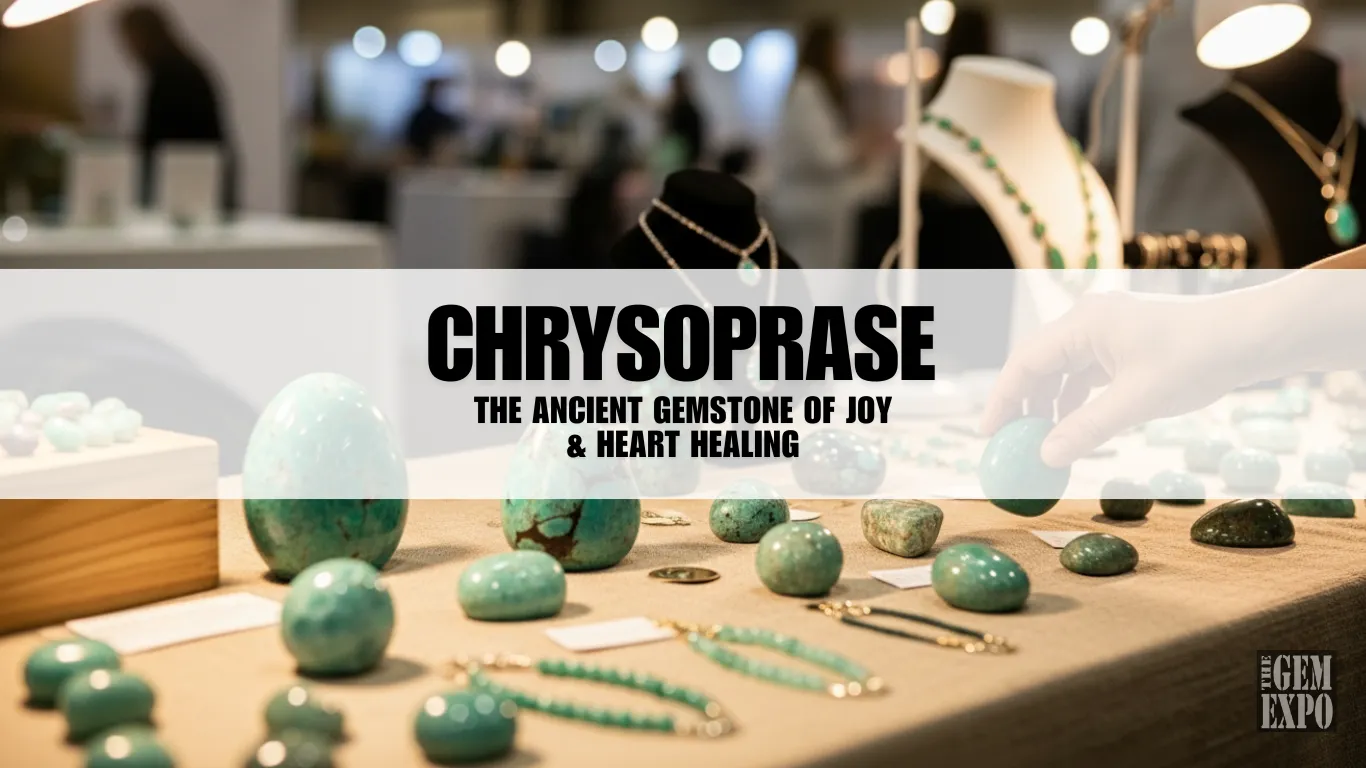

Imagine holding a stone so green it looks like bottled springtime. Cool to the touch, quietly radiant, and carrying a history that stretches back more than three thousand years. That is chrysoprase. Long before modern wellness culture embraced crystals, ancient Egyptians were placing this vivid green gem inside tombs. Alexander the Great wore it on his belt before battle. Prussian kings decorated entire palace rooms with it. There is a reason this stone has never gone out of fashion. It speaks to something deep and genuine in the human heart, and people across every culture who have encountered it have arrived at the same conclusion: this is a stone of joy, compassion, and healing.
Chrysoprase Definition: What Is This Stone?
The chrysoprase definition begins with its geology. Chrysoprase is a variety of chalcedony, a microcrystalline form of quartz. The chrysoprase’s stone gets its signature apple-green colour from trace amounts of nickel absorbed during formation, which is what separates it from emerald, whose green comes from chromium. This distinction tripped up even skilled ancient jewellers, who frequently mistook high-quality chrysoprase crystal for emerald.
The chrysoprase’s Mohs hardness rating sits between 6.5 and 7, making it durable enough for everyday jewellery and robust enough for carving and beadwork. It has a waxy to glassy lustre, a cryptocrystalline structure (meaning its tiny crystals are invisible to the naked eye), and a specific gravity of around 2.6 g/cm³. The name comes from the Greek words chrysos (gold) and prason (leek), a reference to its warm, leek-green colour range.
Chrysoprase’s colors range from pale mint to vivid apple green, with the richest, most saturated green specimens commanding the highest prices. Stones with a blue-green tint are sometimes classified as chrysoprase blue or a blue chrysoprase stone, a rarer variation particularly prized by collectors. There is also chrysoprase citron, a lemon-yellow to yellow-green variety coloured by iron rather than nickel, which has its own distinct following among gem enthusiasts.
Chrysoprase Australian Jade: The Finest Source on Earth
The world’s most celebrated deposit sits in Queensland, Australia, which is precisely why chrysoprase Australian jade, is a term you will hear repeatedly in the gem trade. The Queensland material produces stones of exceptional colour saturation and translucency, often a rich, almost glowing apple green that other deposits rarely match. This is why the nickname stuck. Chrysoprase Australian jade, is not actually jade at all in the mineralogical sense, but the comparison speaks to the stone’s visual richness and its cultural role as a stone of harmony and balance.
Beyond Australia, significant deposits exist in Tanzania, Brazil, Madagascar, Poland, Russia, and parts of the United States. Each source produces slightly different material in terms of colour and translucency, which is why experienced buyers and collectors often ask about provenance when shopping for a chrysoprase stone or chrysoprase agate specimen.
Chrysoprase agate refers to chrysoprase specimens that display the banded or layered patterning more commonly associated with agate. Since both chrysoprase and agate are chalcedony varieties, they can occasionally share characteristics, producing material with the vivid apple-green of chrysoprase’s alongside the visual complexity of banding. chrysoprase’s agate pieces are popular among collectors who want both beauty and structure in a single stone.
A Stone With Three Thousand Years of History
The story of chrysoprase begins in ancient Egypt. Archaeological evidence places it in tombs as far back as 1500 BC, where it was associated with joy, fertility, and renewal. The Egyptians linked the chrysoprase’s meaning to new beginnings and the heart’s capacity to open after loss, which feels remarkably prescient given how the stone is used today.
The Greeks and Romans embraced the chrysoprase crystal with equal conviction. They carved it into seals and signet rings, believing it enhanced wisdom and eloquence. Soldiers reportedly visited the Oracle at Delphi carrying the chrysoprase stone, trusting that its presence would draw out only truthful prophecy. Whether or not that worked, the practice reveals the depth of the stone’s ancient reputation for clarity.
Then there is Alexander the Great. According to the historical writings of Albertus Magnus, the Macedonian king wore a chrysoprase stone on his belt throughout his military campaigns, crediting it with his strategic brilliance. One evening after a great victory, Alexander removed the stone to bathe in a river. A serpent swallowed it before he could recover it, and according to the account, he never won a battle of comparable significance again. Whether legend or history, this anecdote illustrates just how seriously people once took the power of this gem.
By the 18th century, Frederick II of Prussia had become so captivated by chrysoprase’s that he used it to decorate the interior of Sanssouci, his beloved palace near Potsdam. Those original panels still exist today, a testament to the stone’s enduring beauty across centuries. Interestingly, royal courts of that era were equally drawn to other vivid green minerals for their symbolic and decorative power.
If you are curious about how neighbouring stones carried their own traditions, Chrysocolla: The Wise Mineral’s Meaning & Healing Powers explores a kindred gem with a fascinating story of its own.
Chrysoprase Meaning and Crystal Meaning
The chrysoprase’s meaning has remained consistent across cultures and millennia. Joy, optimism, forgiveness, and the opening of a closed heart are themes that recur, whether you are reading about ancient Egyptian burial practices, Roman gem lore, or contemporary crystal healing.
In Buddhist philosophy, the stone symbolises perfection and non-attachment. In Indian traditions, it has long been connected to empathy and the capacity to see others without judgment. The Romans called it the Stone of Venus, linking it to love and the feminine principle. In contemporary practice, the chrysoprase crystal meaning is framed consistently around emotional recovery, self-acceptance, and the quiet joy that comes from being genuinely at peace with who you are.
Furthermore, the chrysoprase definition in modern crystal healing circles expands on its ancient roots. It is described as a stone that works slowly and gently, making shifts that feel natural rather than forced. This is part of why the chrysoprase’s crystal meaning resonates with people who are sceptical of grand spiritual claims but open to the idea that beauty and intention can work together in subtle ways.
At The Gem Expo in Toronto, this emotional dimension of the stone comes up in vendor conversations constantly. Collectors share stories of customers returning to shows to find another piece of chrysoprase’s, often saying that a stone they purchased at a previous event helped them through a genuinely difficult period.
Chrysoprase Chakra and Energy Connections
The chrysoprase chakra connection centres primarily on the heart chakra, located at the center of the chest and associated with love, compassion, forgiveness, and emotional balance. When the heart chakra is open, a person finds it easier to give and receive love, process grief, and release resentment. When it is blocked, they may feel isolated, bitter, or emotionally numb. The chrysoprase chakra work, as described in crystal healing traditions, involves gently activating and clearing that energy centre.
Some practitioners also connect chrysoprase to the solar plexus chakra, the seat of personal will and confidence. In this context, the chrysoprase chakra connection bridges emotional openness with practical motivation, helping align what a person truly desires with the actions they actually take. This dual activation is part of why the chrysoprase crystal benefits are so often described in terms of both emotional and personal empowerment simultaneously.
Chrysoprase Healing Properties and Benefits
The chrysoprase healing properties described here come from centuries of metaphysical tradition. They are not medical claims, and chrysoprase is not a substitute for professional medical or psychological care.
Emotionally
The chrysoprase crystal benefits centre on releasing grief, reducing anxiety, easing loneliness, and building genuine inner contentment. The benefits of chrysoprase for people navigating heartbreak, loss, or major life transitions are particularly well-documented in crystal healing literature. It consistently softens the emotional body without dulling awareness or bypassing real feelings.
Physically
Traditional crystal healing links the chrysoprase benefits to support for reproductive health, improved sleep, liver function, skin health, and hormonal balance. Some practitioners also associate it with fertility support and relief from menstrual discomfort, though these are metaphysical associations rather than medical facts.
Mentally
The chrysoprase healing properties include enhanced creativity, quieting of obsessive thought patterns, and an improved ability to focus on what genuinely matters rather than what anxiety amplifies. For those who want to pair this mental clarity with a stone known for motivation and courageous action, Carnelian Gem – Meaning, Properties & Healing Benefits makes a natural companion read, as the two stones complement each other beautifully in practice.
The benefits of chrysoprase
Extend into daily life in ways that go beyond formal meditation or intentional practice. Many people who carry the stone or wear chrysoprase jewelry simply report feeling calmer, more grounded, and more connected to the present moment. These are the kinds of subtle, lived chrysoprase benefits that are difficult to quantify but easy to appreciate.
Chrysoprase vs. Chrysocolla: Clearing Up the Confusion
Chrysocolla vs chrysoprase is one of the most common questions buyers ask at gem shows, and understandably so. Both stones are vivid green to blue-green, and both carry heart-centred energy. Here is how to tell them apart:
| Feature | Chrysoprase | Chrysocolla |
|---|---|---|
| Mineral family | Chalcedony (quartz) | Copper silicate |
| Hardness (Mohs) | 6.5 to 7 | 2.5 to 3.5 |
| Colour source | Nickel | Copper |
| Typical colours | Apple green, mint, blue-green | Turquoise, teal, blue-green |
| Surface lustre | Waxy to glassy | Earthy to waxy |
| Primary association | Joy, heart healing, emotional balance | Communication, calm, goddess energy |
The key practical difference in the chrysocolla vs chrysoprase’s comparison is hardness. Chrysocolla is quite soft and fragile, making it unsuitable for rings or bracelets that see daily wear. chrysoprase’s, with its chrysoprase Mohs rating of 6.5 to 7, is considerably more durable and well-suited to all forms of chrysoprase’s jewelry. When evaluating chrysocolla vs chrysoprase in person, note that chrysocolla often has a more matte or earthy finish, while chrysoprase’s tends toward a translucent, glassy appearance.
Chrysoprase Birthstone: Which Signs Does It Serve?
The chrysoprase birthstone connection is primarily with Gemini (May 21 to June 20), though some traditions also link it to Libra and Taurus. As a chrysoprase birthstone, it supports Gemini’s natural curiosity and communication gifts while providing the emotional grounding that air signs can sometimes lack. It is also considered a May birthstone alternative, sitting alongside emerald in some traditions. For anyone born in May who finds emerald too bold or too expensive, chrysoprase, as a chrysoprase birthstone, offers a gentler, equally beautiful option.
Chrysoprase’s Jewellery, Beads, and Wearable Forms
One of the most accessible ways to work with chrysoprase is through chrysoprase jewelry. The stone’s hardness and smooth texture make it well-suited to cabochons, beads, and faceted cuts, and its vivid colour means it stands beautifully on its own without needing elaborate settings.
Chrysoprase bracelet
Is one of the most popular wearable forms. Designs range from simple elastic bead bracelets to elegant sterling silver settings with polished cabochons. A chrysoprase’s bracelet worn on the left wrist, which many crystal practitioners consider the receiving side of the body, is a favoured choice for people working intentionally with the stone’s heart energy.
Chrysoprase beads
are widely used in both strung jewellery and loose bead collections. They come in round, oval, and faceted cuts, and their smooth surface makes them pleasant to handle. A chrysoprase’s beaded necklace is one of the most practical wearable forms, keeping the stone close to the heart throughout the day. For anyone working with the chrysoprase’s chakra connection to the heart centre, a chrysoprase’s beaded necklace worn at chest length makes intuitive sense.
Chrysoprase jewelry
set in gold, whether yellow or rose, is particularly striking because the warm metal tones complement the cool apple green of the stone beautifully. Sterling silver settings are more common and equally elegant. When shopping for chrysoprase’s jewelry, look for stones with consistent colour, good translucency, and smooth surface polish. Chrysoprase beads should be free of cracks or pitting, and a chrysoprase bracelet should use quality findings that will hold up to daily wear.
At The Gem Expo, you will find chrysoprase jewelry from artisans across Canada and internationally, including handcrafted pieces that showcase the full range of chrysoprase colors from pale mint to deep apple green. If you are building a gemstone jewellery collection and want to understand how to assess value, pair stones wisely, and invest smartly in 2026, Amber Guide – Benefits, Value & Jewelry Tips is a worthwhile resource that covers the kind of practical buying knowledge every collector benefits from knowing.
How to Use and Care for Chrysoprase
Step 1: Choose your piece with intention
At a live gem show like The Gem Expo, hold multiple pieces. The richest apple-green colour and highest translucency generally indicate the best quality material. For chrysoprase beads or a chrysoprase beaded necklace, look for consistent colour throughout the strand. For chrysoprase colors in the blue-green range, ask the vendor whether the material is a true blue chrysoprase stone or simply a lighter-coloured green variety.
Step 2: Set a clear intention before you begin
Whether you are working with the chrysoprase crystal meaning for emotional healing, exploring the chrysoprase chakra connection, or simply enjoying its beauty, being specific about your intention focuses your experience.
Step 3: Meditate with the stone
Hold your chrysoprase crystal in your palm, breathe slowly, and allow yourself to settle. Many practitioners recommend doing this outdoors or near natural light, as chrysoprase has a strong resonance with the natural world. Morning and evening light are considered particularly supportive times.
Step 4: Wear it consistently
A chrysoprase’s bracelet, ring, or chrysoprase beaded necklace keeps the stone’s energy present throughout the day. Paired with rose quartz, it deepens emotional healing. Paired with clear quartz, it amplifies the chrysoprase crystal benefits.
Step 5: Care for your stone properly
Clean chrysoprase with warm soapy water and a soft cloth. Keep it away from harsh chemicals and prolonged direct sunlight, as UV exposure can fade the colour over time. The chrysoprase’s Mohs hardness of 6.5 to 7 means it is durable, but it should still be stored separately from harder stones like topaz or sapphire to avoid surface scratching. If your chrysoprase stone loses some vibrancy, wrapping it in a damp cloth for 10 to 15 minutes can help restore its colour.
Step 6: Rest and integrate
Some practitioners suggest pausing work with the stone every 10 to 14 days, allowing time to integrate the emotional shifts that the chrysoprase healing properties may have supported.
Where to Find Chrysoprase in Canada
If you are in Canada and looking to explore chrysoprase’s stone, chrysoprase’s jewelry, chrysoprase’s beads, or raw specimens, The Gem Expo is one of the finest places to start. Held three times yearly at the Hyatt Regency Toronto, the show brings together trusted vendors from across Canada and internationally, offering everything from chrysoprase’s Australian jade cabochons to handcrafted chrysoprase’s bracelet designs and chrysoprase’s beaded necklace pieces in sterling silver.
Shopping at a live gem show gives you what online shopping cannot: the ability to hold the stone, compare chrysoprase colors side by side, ask about provenance, and speak with the people who actually sourced the material. For a gem as visually nuanced as chrysoprase’s, where the difference between a dull, washed-out piece and a richly saturated, high-quality stone is significant, that hands-on experience is genuinely valuable.
Visit the rock and gem expo for upcoming gem show dates, vendor information, and ticketing details.
FAQs
Can chrysoprase fade permanently, and is there a way to restore its colour at home?
Chrysoprase can fade with prolonged exposure to direct sunlight or UV light, but in most cases this is not permanent. The colour loss happens because nickel-based pigmentation in the stone is sensitive to sustained heat and light. To restore vibrancy at home, wrap your chrysoprase in a clean damp cloth and leave it for 10 to 15 minutes. This rehydrates the stone's microcrystalline structure and often brings the green colour back noticeably. To prevent future fading, store your chrysoprase away from windowsills and direct sunlight, and avoid leaving it in hot environments such as a car dashboard in summer. If the stone is set in jewellery, remove it before sunbathing or using UV nail lamps.
How can you tell if a chrysoprase stone is real or dyed green chalcedony?
Genuine chrysoprase has a natural translucency with colour distributed evenly throughout the stone, not concentrated near the surface or along cracks. Dyed chalcedony, on the other hand, often shows deeper colour saturation along fracture lines and edges where the dye has absorbed most heavily. Under a loupe or magnifying glass, dyed stones frequently reveal uneven colour pooling. A genuine chrysoprase stone also feels slightly waxy to the touch when unpolished, whereas dyed stones tend to look artificially bright and uniform under direct light. When shopping at The Gem Expo, always ask vendors directly about the stone's origin and treatment history. Reputable vendors will disclose whether a stone is natural or colour-treated without hesitation, which is one of the genuine advantages of buying at a live gem show.
What gemstones pair best with chrysoprase in jewellery and crystal healing practice?
Chrysoprase works beautifully with several stones depending on what you are trying to achieve. For deepened emotional healing, rose quartz is the most natural pairing because both stones work on the heart chakra and complement each other's gentle, compassionate energy without overpowering one another. For amplification of the chrysoprase crystal benefits, clear quartz is the go-to choice, as it magnifies the energy of whatever stone it accompanies. For grounding and stability alongside emotional work, black tourmaline provides an earthy anchor that keeps the heart-centred energy of chrysoprase from feeling unmoored. For creativity and confidence, pairing chrysoprase with carnelian is particularly effective since carnelian activates the sacral chakra and adds motivated, action-oriented energy to chrysoprase's calming clarity. In jewellery terms, chrysoprase pairs visually with white moonstone, pearl, and labradorite for an elegant, nature-inspired aesthetic that showcases the apple-green colour without competition.
Does chrysoprase work differently depending on which zodiac sign you are, and which signs benefit most?
Yes, while chrysoprase benefits everyone at a general level, its resonance shifts meaningfully depending on your sign. Gemini benefits most directly since chrysoprase is the traditional Gemini birthstone. It calms Gemini's tendency toward mental overload and emotional restlessness, bringing focus and warmth to a sign that often lives too much in the mind. Taurus benefits from chrysoprase's ability to soften the sign's fixed, sometimes guarded emotional nature, encouraging flexibility and open-heartedness without undermining the natural Taurean stability. Libra, ruled by Venus, finds chrysoprase a natural ally because both share an association with beauty, love, and balanced relationships. For Libra, the stone supports confident decision-making and reduces the anxiety that often comes from the sign's tendency to weigh all options endlessly. Cancer responds strongly to chrysoprase's nurturing, self-compassion energy, helping this deeply empathetic sign release emotional burdens it tends to carry for others. Pisces finds chrysoprase grounding in a positive sense, helping the sign maintain emotional clarity and release past wounds without losing its natural compassion. If you are an earth or air sign, chrysoprase is considered particularly compatible. Fire signs can use it effectively for emotional recovery after intense periods, while water signs benefit most during transitions and times of grief.
Is chrysoprase safe to wear every day, or does it require special care for rings and bracelets?
Chrysoprase is generally suitable for everyday wear given its Mohs hardness of 6.5 to 7, which places it in the same durability range as many commonly worn gemstones. However, a few practical considerations matter. For rings, which take the most physical impact of any jewellery type, a protective setting such as a bezel or halo that shields the stone's edges is strongly recommended over a prong setting that leaves the stone exposed. For a chrysoprase bracelet, avoid wearing it during activities that involve contact with hard surfaces, as repeated knocking can cause surface scratching over time. Always remove chrysoprase jewellery before swimming in chlorinated pools, using cleaning products, or applying perfume directly onto the stone, as chemicals accelerate colour fading. Store it separately from harder stones like sapphire, topaz, or diamonds, which can scratch its surface. With basic care, a well-set chrysoprase bracelet or ring can be a genuinely durable everyday piece that maintains its beauty for many years.
Final Thoughts
Chrysoprase has earned its place in human history not through trends but through thousands of years of genuine appreciation across cultures that never shared a language or a border. From Egyptian tombs to Prussian palaces, from Greek oracles to Canadian gem shows, this vivid green stone keeps appearing wherever people are searching for joy, emotional healing, and a more open heart.
Whether you come to it as a collector drawn to the rarity of chrysoprase’s Australian jade, a crystal practitioner exploring the chrysoprase’s healing properties, a jewellery lover seeking the perfect chrysoprase’s bracelet, or simply someone curious about the natural world, the chrysoprase’s benefits are waiting to be discovered. It is a stone that rewards attention, and given what history tells us about the people who have loved it most, that is exactly as it should be.
Discover chrysoprase and hundreds of other gemstones, minerals, and handcrafted jewellery pieces at The Gem Expo in Toronto. Visit The Gem Expo for show dates and vendor details.