

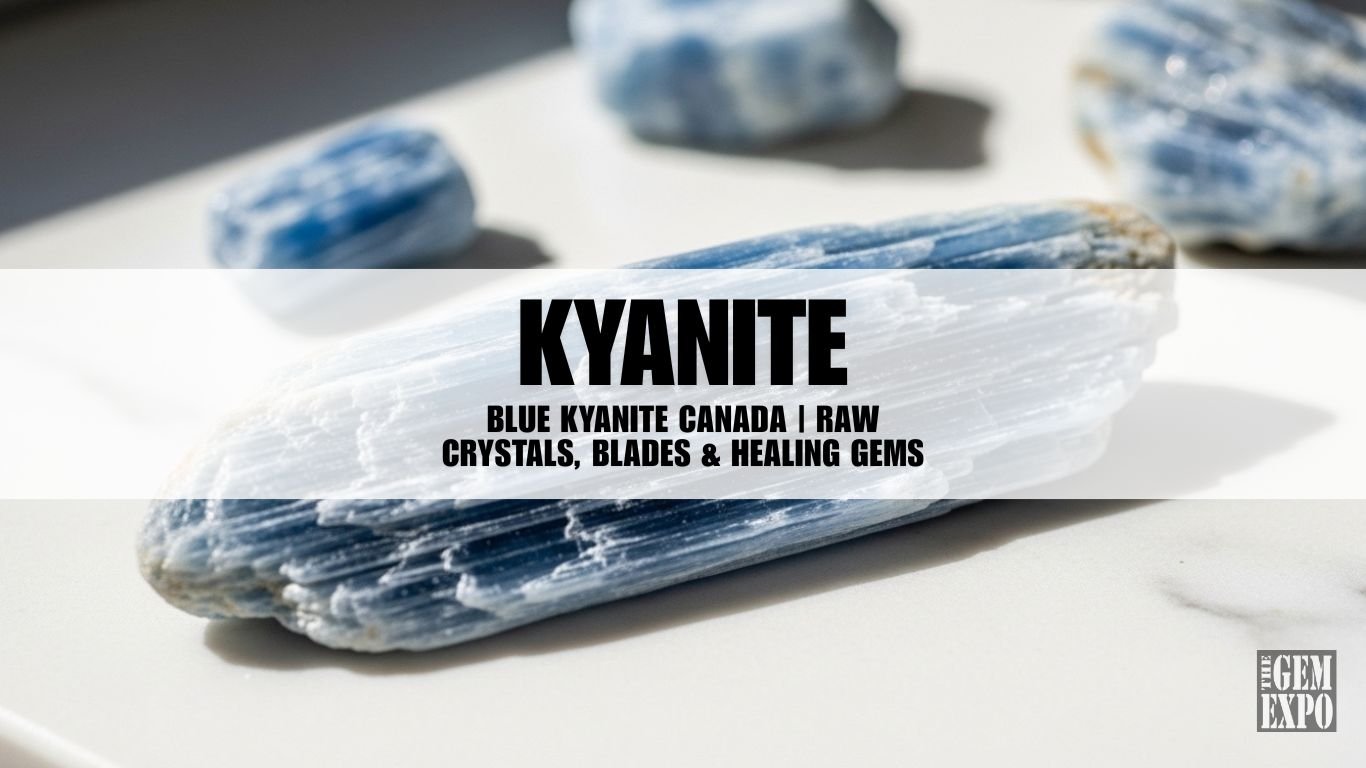

A few years ago, a first-time visitor to The Gem Expo picked up a raw blade from a vendor’s table, held it under the light, and just went quiet. No words. Just this long pause. Then she said, “I’ve never felt a crystal do that before.” She was holding a piece of blue kyanite, and that moment is honestly one of the best ways to describe what this gem does to people. It stops them cold. In the best way.
If you’re new to blue kyanite or you’re trying to learn more before buying, you’re in the right place. This guide covers everything: what it is, where it comes from, what it actually does, and how to pick the right piece for you right here in Canada.
What Is Blue Kyanite?
Blue kyanite is a naturally forming aluminium silicate mineral. Its name comes from the Greek word kyanos, which simply means blue. That colour, usually a calm, deep, ocean-like blue, is the most well-known version of this gem, though it also appears in green, black, and orange varieties.
The kyanite crystal grows in long, flat blades. That’s one of the things that makes it so easy to spot. Unlike rounded tumbled crystals, a raw kyanite blade looks almost carved, thin, elongated, with visible striations running along the length. It’s formed deep inside metamorphic rocks under intense pressure, which is part of why so many people feel such a strong energy from it.
Where is kyanite found? The primary sources are Brazil, Nepal, India, and Tanzania. Brazilian kyanite is known for its vivid, saturated blue. Nepali and Indian kyanite often shows a more silvery-blue, almost ocean-like sheen. At The Gem Expo, you’ll find verified specimens from trusted vendors, not lab-grown substitutes or dyed lookalikes.
Blue Kyanite Meaning: What It Represents
The blue kyanite meaning is deeply tied to communication and clarity. It is connected to the Throat Chakra, the energy centre that governs how we speak our truth, how we listen, and how we express ourselves. When that chakra is out of balance, people often feel like they can’t say what they really mean. They hold back. They second-guess. Blue kyanite is believed to gently open that up.
It is also linked to the Third Eye Chakra, which is connected to intuition, inner knowing, and awareness beyond the surface level. The blue kyanite spiritual meaning is therefore one of alignment, between what you think, what you feel, and what you say.
One thing that sets kyanite apart from most other crystals is this: it is widely considered one of the only minerals that does not absorb negative energy. Most crystals need to be cleansed regularly to clear the energy they pick up. Kyanite is said to be self-clearing. It simply doesn’t hold onto what doesn’t serve it. For many crystal users, that makes it a foundational piece, something that can be used daily without needing a reset.
The meaning of blue kyanite varies slightly across traditions, but the common threads are always: truth, clarity, calm, and alignment.
Kyanite Healing Properties: What People Experience
The kyanite healing properties that are most commonly reported fall into a few clear categories. It helps to understand these not as medical claims, but as the lived experiences shared by collectors, energy workers, and everyday people who use crystals in their wellness routines.
Emotional calm is one of the most frequently mentioned effects. The blue kyanite healing properties are often described as cooling, people say it helps bring down anxiety, slow racing thoughts, and create a sense of stillness even in stressful moments.
Better communication is another. Writers, teachers, therapists, and anyone who works with words often reach for kyanite when they’re feeling blocked or misunderstood. It’s sometimes kept on a desk during difficult conversations or worn as a kyanite necklace during presentations and meetings.
Meditation support is where kyanite truly shines. Because of its Third Eye connection, the kyanite crystal benefits during meditation are said to include deeper focus, sharper intuition, and a faster entry into a calm, receptive mental state. Many energy workers use a kyanite blade as a kind of energetic tool, passing it over the body’s energy field to encourage flow and release blockages.
Sleep and stress are also part of the conversation. Some users place kyanite near their bed or under their pillow to help quiet an overactive mind before sleep.
| Property | Effect Commonly Reported |
|---|---|
| Chakra | Throat & Third Eye |
| Emotional | Calm, reduced anxiety, emotional clarity |
| Communication | Clearer expression, reduced conflict |
| Meditation | Deeper focus, heightened intuition |
| Self-clearing | Does not require regular cleansing |
| Hardness | 4.5–7 on the Mohs scale (varies by axis) |
Kyanite Mohs Hardness: What You Need to Know Before Buying
One practical thing worth knowing: kyanite Mohs hardness is unusual. Unlike most minerals, kyanite has two different hardness ratings depending on direction. Along the blade (lengthwise), it measures about 4.5 on the Mohs scale. Across the blade (perpendicular), it measures closer to 6.5–7. This is called anisotropy, and it’s one of kyanite’s defining scientific features.
What does this mean for you? It means blue kyanite can chip if handled roughly along its softer axis. Raw blades especially should be kept somewhere safe, not rattling around in a bag with harder crystals. Treat them gently, and they’ll last for decades.
Types of Kyanite Worth Knowing
Most people come looking for blue kyanite, but it helps to know the whole family:
Black kyanite grows in fan-like formations rather than blades. Its energy is considered grounding and protective, good for shielding and clearing heavy or unwanted energy. Many crystal workers use black kyanite before working with blue kyanite, ground first, then open up.
Green kyanite is rarer and is associated with the Heart Chakra. It’s often connected to growth, nature, and emotional healing. True green kyanite is harder to source than blue, which makes quality specimens more valuable.
Ruby kyanite (also called ruby in kyanite or ruby with kyanite) is a naturally occurring combination mineral where deep red ruby is embedded within a kyanite matrix. The pairing of ruby and kyanite creates a striking visual and is believed to combine kyanite’s alignment energy with ruby’s passion and vitality. Kyanite and ruby specimens from India are particularly sought after by collectors at gem shows across Canada.
Kyanite titanium (often called titanium aura kyanite) is natural kyanite that has been bonded with titanium vapour, giving it a rainbow iridescent surface. It’s loved for its visual beauty, though purists often prefer untreated natural specimens.
Ocean kyanite is a trade name sometimes used for kyanite with a particularly blue-green, sea-like colouration, reminiscent of coastal water in British Columbia on a clear day.
How to Choose the Right Blue Kyanite: A Step-by-Step Guide
Whether you’re shopping at The Gem Expo gem show or browsing online, here’s how to make a smart pick:
Step 1: Decide on raw vs. polished
Raw kyanite blades are best for energy work and meditation. Polished pieces or tumbled forms are more practical for everyday carry or wearing as a necklace.
Step 2: Check the colour saturation
Good quality blue kyanite has a clear, even blue tone. Pale, washed-out pieces are lower grade. Very dark navy pieces can be beautiful too. It’s largely personal preference.
Step 3: Look at the striations
Healthy kyanite blades will have visible lines running lengthwise. These are natural features, not flaws. Avoid pieces with obvious cracks across the blade rather than along it.
Step 4: Ask about origin
Brazilian kyanite, Nepali kyanite, and Indian kyanite each have slightly different energetics and aesthetics. Knowing where your piece is from is part of understanding what you’re holding.
Step 5: Trust your hands
If you’re buying in person at a Canadian gem and crystal event, hold a few pieces. Crystal people will tell you that the right one makes itself known. It sounds simple, but it works.
Step 6: Consider pairings
Kyanite works beautifully alongside clear quartz (amplification), amethyst (intuition), and ruby kyanite combinations (energy + alignment). Ask vendors at The Gem Expo about pairing recommendations, most are genuinely passionate about helping you find what fits.
The Metaphysical Properties of Kyanite: Going a Little Deeper
The metaphysical properties of kyanite have been documented across various healing and spiritual traditions for centuries. In ancient times, travellers were said to use suspended kyanite as a natural compass because of the mineral’s magnetic sensitivity. That story may be more legend than fact, but it speaks to something real: kyanite has always been associated with finding direction.
In contemporary crystal healing, the kyanite properties are broadly understood as: alignment (bringing the chakras into balance), attunement (helping you tune into subtle energy), and amplification of intention. Because it is self-clearing, it is also considered a teaching crystal, one that helps people develop their own energetic sensitivity over time.
The kyanite crystal meaning is often summarised as “the crystal of connection”, connecting mind to voice, intuition to action, and the inner world to the outer one.
Where to Find Blue Kyanite in Canada
If you’re in Canada and you want to see, touch, and genuinely connect with blue kyanite before buying, The Gem Expo is your best option. It’s one of Canada’s longest-running gem and mineral shows, bringing together dozens of verified vendors who carry everything from raw kyanite blades and tumbled pieces to kyanite set in jewellery and ruby kyanite collector specimens.
Shopping at The Gem Expo means you’re buying from people who know their product. You can ask where a piece is from, how it was collected, and what they personally love about it. That kind of knowledge is hard to find online and impossible to fake in person.
You can explore upcoming gem show dates and locations on their website, and if you’re a crystal enthusiast looking to discover more than just kyanite, you’ll also find vendor profiles from across the country to browse before you arrive.
FAQs
Can blue kyanite get wet or be cleansed with water?
Blue kyanite should not be soaked in water for long periods. Because of its layered blade structure and variable Mohs hardness (as low as 4.5 on its softer axis), prolonged water exposure can cause surface damage or weakening along the cleavage lines. Instead, cleanse it by placing it in moonlight, using sound (singing bowl or bell), or setting it near selenite. Since kyanite is widely considered self-clearing, most users find no cleansing is needed at all.
Is blue kyanite rare or easy to find in Canada?
Quality blue kyanite is not as widely available in Canadian retail shops as more common crystals like amethyst or quartz. Most mass-market stores carry very few specimens, and what they do stock is often unlabelled or of uncertain origin. Verified, origin-labelled blue kyanite, especially larger raw blades and ruby kyanite combinations, is best sourced through specialist gem shows and trusted crystal vendors, where you can confirm authenticity directly.
What is the difference between blue kyanite and blue apatite?
These two crystals are frequently confused because they share a similar colour range. Blue apatite is softer (Mohs 5), more glassy in appearance, and often found in rounder, more uniform shapes. Blue kyanite is distinctly bladed, has a silky or pearly lustre along its surface, and grows in elongated flat forms that apatite does not. Energetically, apatite is associated with motivation and mental clarity, while kyanite is linked to alignment, communication, and chakra balancing.
How do you tell real blue kyanite from fake or dyed crystals?
Genuine blue kyanite always grows in bladed, striated formations, long, flat, with visible lines running lengthwise. The colour is typically uneven and varies slightly across the blade, which is a sign of natural formation. Fakes or dyed pieces tend to have suspiciously uniform, overly saturated colour with no variation. Real kyanite also feels cool and slightly heavy for its size. When in doubt, buy from vendors who provide origin information and are willing to answer questions about their sourcing.
Can blue kyanite be worn every day in jewellery?
Yes, but with some care. Because kyanite's hardness varies by axis, it is more suited to pendants and earrings than rings, which take more daily impact. A kyanite necklace or pendant is actually ideal. It sits close to the throat, which aligns directly with its primary chakra association. Sterling silver settings are recommended over high-friction designs. Avoid storing kyanite jewellery alongside harder gemstones like diamonds, sapphires, or topaz, which can scratch it.
A Final Thought
Blue kyanite is not a flashy crystal. It doesn’t shimmer like labradorite or glow like selenite. What it does is quieter, and honestly more useful: it brings things into alignment. Your words with your thoughts. Your intuition with your actions. Your energy with your intention.
That woman at the gem show who went quiet holding her first kyanite blade? She bought three pieces that day, one for herself, one for her daughter, and one for her desk at work. Some crystals you hold once and just know.
This might be one of those.
Published by The Gem Expo. Canada’s trusted home for verified crystals, minerals, and gems. Explore our vendor community and find your next piece at an upcoming gem show near you.