
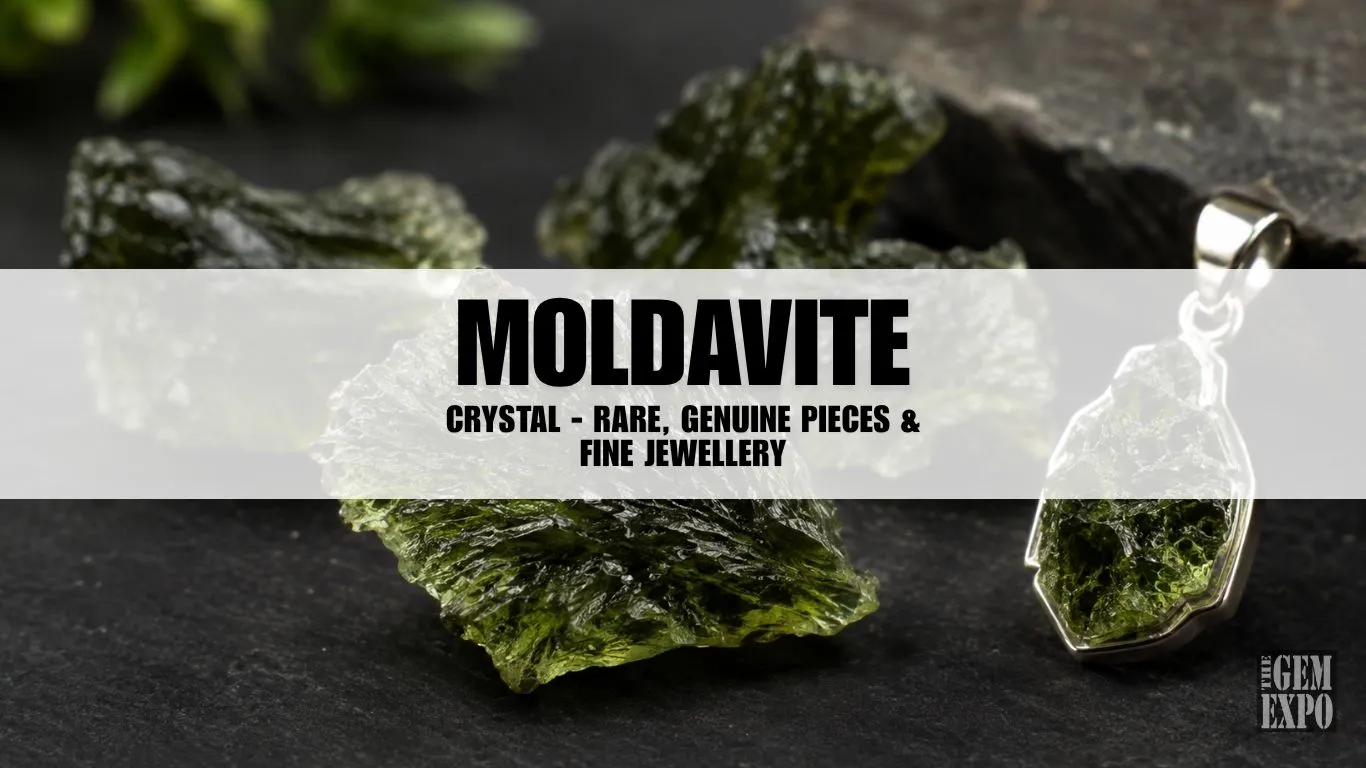

A rock fell from the sky roughly 15 million years ago, and it’s still changing hands today. That’s not an exaggeration. The Moldavite crystal you’re reading about right now was born the moment a giant meteorite slammed into what is now the Czech Republic, melting the ground into glass and flinging it across hundreds of kilometres. Nothing else on Earth has that exact origin story, and that’s part of why so many people go searching for one.
If you’ve landed here wondering what is moldavite, why it costs what it costs, or whether the piece you’re eyeing online is even real, you’re in the right place. Moldavite collectors and beginners tend to have the same questions, so this guide walks through all of them in plain language. And if you’d rather see genuine pieces in person before buying, The Gem Expo’s next show runs November 27-29 at the Hyatt Regency Toronto, where you can hold real moldavite in your hand before deciding.
What Is Moldavite Crystal, Really?
So, what is moldavite? It’s a tektite, which is a fancy word for natural glass. When that meteorite hit the ground near the Moldau River (hence the name), the heat was so intense that it liquefied the local rock and sand. That molten material shot into the air, cooled rapidly, and hardened into the small, wrinkled, forest-green fragments now known as moldavite stone.
Because it’s glass rather than a mineral, moldavite doesn’t have the crystal lattice structure that quartz or amethyst has, even though it’s commonly grouped with moldavite crystals in everyday conversation. It’s classified as a mineraloid. The Natural History Museum’s tektite research explains how these impact events fuse silica-rich rock into glass in seconds, which is part of what makes moldavite rocks so scientifically interesting and not just a pretty green stone.
Here’s the anecdote worth knowing: archaeologists found moldavite amulets buried alongside the Venus of Willendorf, a carving dated to roughly 25,000 years old. People have been drawn to this stone since before written history, long before anyone understood where it actually came from.
Moldavite Crystal Meaning and Moldavite Spiritual Meaning
The moldavite meaning attached to this stone today comes mostly from the crystal healing community, where it’s nicknamed the “Stone of Transformation.” Whether or not you believe in that side of things, it’s worth knowing why the reputation exists. If you’re curious how that compares to other well-known healing stones, our guide to labradorite’s shifting colours covers a similar mix of geology and folklore.
The moldavite spiritual meaning usually centres on three ideas:
- Rapid personal change. People say working with it speeds up whatever transformation is already happening in their life.
- Heart and third eye connection. It’s often paired with the heart chakra and used during meditation.
- The “moldavite flush.” Many first-time users report a warm, tingling sensation when they hold it, which practitioners describe as the stone’s energy making contact.
None of this is scientifically proven, and it’s fair to stay sceptical. What is measurable is the stone’s rarity, its age, and its one-of-a-kind formation, which alone explains a good chunk of its appeal.
Moldavite Benefits and Moldavite Crystal Benefits People Talk About
When people search for moldavite benefits, they’re usually asking one of two things: does it actually do anything, or is it just a nice-looking rock? The honest answer sits in the middle. The moldavite crystal benefits reported by users are subjective and personal, not clinical, but they’re consistent across a lot of independent accounts.
Commonly reported moldavite stone benefits include:
- A sense of clarity during meditation
- Reduced feelings of being emotionally “stuck”
- Increased vividness in dreams after keeping it nearby
- A stronger sense of intuition, according to long-time users
Does moldavite work in a scientific sense? There’s no peer-reviewed evidence for its metaphysical claims, so it’s best treated the way most spiritual tools are treated: as something that may support a mindset shift rather than something with a measurable mechanism. If you want to explore other stones with grounding properties for comparison, our piece on bloodstone’s protective folklore is a good next read.
Moldavite Colours and Different Types of Moldavite
Not all moldavite looks the same, and this is where a lot of buyers get confused. Below is a quick breakdown of the different types of moldavite you’ll come across.
| Colour Variety | How Common | What to Know |
|---|---|---|
| Forest/olive green | Very common | The classic, most recognizable shade |
| Dark moldavite | Common | Deep green, almost black in low light |
| Black moldavite crystal | Rare | Extremely dark, often mistaken for obsidian |
| Blue moldavite | Very rare, disputed | Genuine blue moldavite is contested by many gemologists |
| Brown moldavite | Uncommon | Usually a sign of surface weathering, not a separate variety |
If a listing shows blue moldavite or brown moldavite at a bargain price, treat it with caution. Most gemologists agree that natural moldavite forms in shades of green, and anything wildly outside that range deserves a closer look before you buy.
How to Spot Authentic Moldavite
This is the part most guides skip, and it’s the part that actually protects your wallet. Authentic moldavite has been imitated with green glass for decades, so knowing the difference between real moldavite and a lookalike matters more than almost anything else on this list.
Here’s a simple step-by-step way to check:
Step 1: Look for bubbles in moldavite crystal.
Genuine pieces almost never have perfectly round air bubbles. Real moldavite shows elongated, worm-like internal flow lines called lechatelierite, formed as the molten glass cooled and stretched. A cast glass fake usually shows round, uniform bubbles instead.
Step 2: Check the surface texture.
Authentic moldavite has an irregular, sculpted, almost melted appearance. Fakes tend to look too smooth or too symmetrical.
Step 3: Ask about hardness.
How hard is moldavite? It sits around 5.5 on the Mohs scale, similar to glass. This won’t tell you much on its own, but a seller who can’t answer this question at all is a red flag.
Step 4: Request documentation.
Reputable sellers of authentic moldavite jewellery provide a certificate of authenticity. If none is offered, ask before buying.
Step 5: Compare weight and colour saturation.
Real moldavite is lighter than most people expect and rarely has a uniform, glossy colour throughout.
If you’d rather skip the guesswork entirely, visiting vetted sellers in person is the safer route. You can browse The Gem Expo’s vendor list ahead of the next show to see who specializes in tektites and rare specimens.
Can Moldavite Be Polished, and Should It Be?
This question comes up constantly. Can moldavite be polished? Technically yes, lapidaries do cut and facet it, but it’s a genuinely difficult material to work with because those internal bubbles tend to surface and break during cutting. A skilled cutter treats every piece as a puzzle. Most collectors actually prefer raw, unpolished moldavite because the natural, wrinkled texture is part of what makes it recognizable and part of what makes it valuable in the first place.
Moldavite Jewellery Worth Knowing About
Moldavite jewellery has grown steadily more popular, especially in sterling silver settings that let the stone’s texture stay visible instead of being hidden under heavy prongs. Authentic moldavite jewellery pieces, whether pendants, rings, or earrings, tend to showcase the raw or lightly shaped stone rather than a heavily faceted cut, since that rawness is part of the appeal buyers are actually paying for.
If you’re building out a collection, it’s worth pairing moldavite with complementary stones. A piece on aquamarine’s calming blue tones or a set featuring citrine’s warm energy can round out a personal collection nicely alongside a single moldavite centerpiece.
Do You Need to Charge Moldavite?
Does moldavite need to be charged? Among crystal practitioners, “charging” usually means cleansing a stone under moonlight or sunlight to reset its energy. Moldavite doesn’t require this the way some believe quartz does, since its intensity is considered constant rather than something that fades. That said, many owners still cleanse it periodically, simply out of habit or ritual comfort, and there’s no harm in doing so.
As for the effects of moldavite that people report after wearing it regularly, they tend to describe a gradual, cumulative shift rather than anything sudden. It’s usually framed as a slow-building companion stone rather than a quick fix.
Where to Buy Moldavite in Canada
If you’re trying to buy moldavite Canada wide, you have two realistic paths: online marketplaces, or in-person shows where you can inspect a piece before paying for it. Searching to buy moldavite near me online can turn up mixed results, since authenticity varies wildly between sellers, and photos alone rarely tell the full story.
This is exactly the gap The Gem Expo fills. Rather than trying to buy real moldavite from a stranger’s listing, our Toronto show brings together vetted vendors under one roof, so you can compare pieces side by side, ask questions directly, and buy moldavite stone with far more confidence than a blind online purchase allows. It’s also where you’re most likely to come across a genuinely large specimen, since the biggest piece of moldavite in any collection is usually the one a serious collector has been hunting for years, not something that shows up in a casual search.
Our next show runs November 27-29 at the Hyatt Regency Toronto, with vendors covering everything from raw moldavite rocks to finished jewellery. Tickets are available now, and it’s the easiest way to see genuine moldavite crystal pieces in person before spending your money.
A Quick Note on Value and Rarity
Because moldavite only comes from a small strewn field in Central Europe, supply is genuinely limited, unlike mined gemstones that can be sourced from multiple countries. Prices are typically set by weight, clarity, and how dramatic the surface texture is. A larger, well-shaped piece with strong flow patterns will always cost more than a small chip, and that pricing logic hasn’t really changed in years. For a broader sense of how rarity affects pricing across different stones, our breakdown of ametrine’s dual-toned value applies the same basic principles.
FAQs
How much does moldavite cost per gram?
Genuine moldavite typically runs anywhere from $20 to $150 per gram, depending on grade, shape, and how much natural texture the piece has kept. Small, common fragments sit at the lower end, while large, well-formed collector pieces with strong flow patterns can climb well past $150 per gram. Faceted moldavite is priced differently again, since cutting removes weight and surface texture that raw pieces are valued for.
What are moldavite grades, and does grade affect price?
Moldavite is generally sorted into Class A, AA, and AAA. Class A is the most common and most affordable, with visible surface texture and typical olive-green tone. Class AA shows cleaner surfaces and richer colour, and Class AAA represents the rarest, most sculpted, museum-quality pieces. As grade goes up, price climbs sharply, since true AAA-grade moldavite is genuinely hard to find.
How do you clean and care for moldavite jewellery?
Moldavite only needs a soft, damp cloth to stay clean. Avoid harsh chemicals, ultrasonic cleaners, and prolonged soaking, since it's a glass-based material and can be damaged by both rough handling and extended water exposure. A quick wipe after wear and occasional gentle washing with mild soap is enough to keep it looking its best.
Is it safe to wear moldavite every day, and can it get wet?
Yes, moldavite is generally safe for daily wear, though it sits at around 5.5 on the Mohs hardness scale, so it can scratch more easily than harder gemstones like quartz or sapphire. It can handle brief contact with water, such as washing your hands, but it shouldn't be worn while swimming or submerged for long periods, since prolonged moisture exposure can affect the surface over time.
What's the difference between moldavite and peridot?
They're often confused because both are green, but they're completely different materials. Peridot is a crystalline mineral (a form of olivine) formed inside the Earth's mantle, while moldavite is a non-crystalline natural glass formed by a meteorite impact. Peridot has a more uniform, gem-like clarity and a lighter, more yellow-green tone, while moldavite shows the darker, textured, flow-marked surface typical of tektites.
Final Thoughts
The moldavite crystal carries a story that very few other stones on Earth can claim: a meteorite impact, a fifteen-million-year wait, and a surface texture that can’t be faked by machine. Whether you’re drawn to it for the moldavite meaning, the moldavite crystal benefits people describe, or simply because it’s one of the rarest natural materials you can hold in your hand, doing your homework before buying protects both your money and your experience with the stone.
If you want to see real, verified moldavite alongside dozens of other rare specimens, The Gem Expo’s November 27-29 show at the Hyatt Regency Toronto is where collectors, vendors, and curious first-timers meet under one roof. Come hold a piece for yourself before deciding which one is right for you.