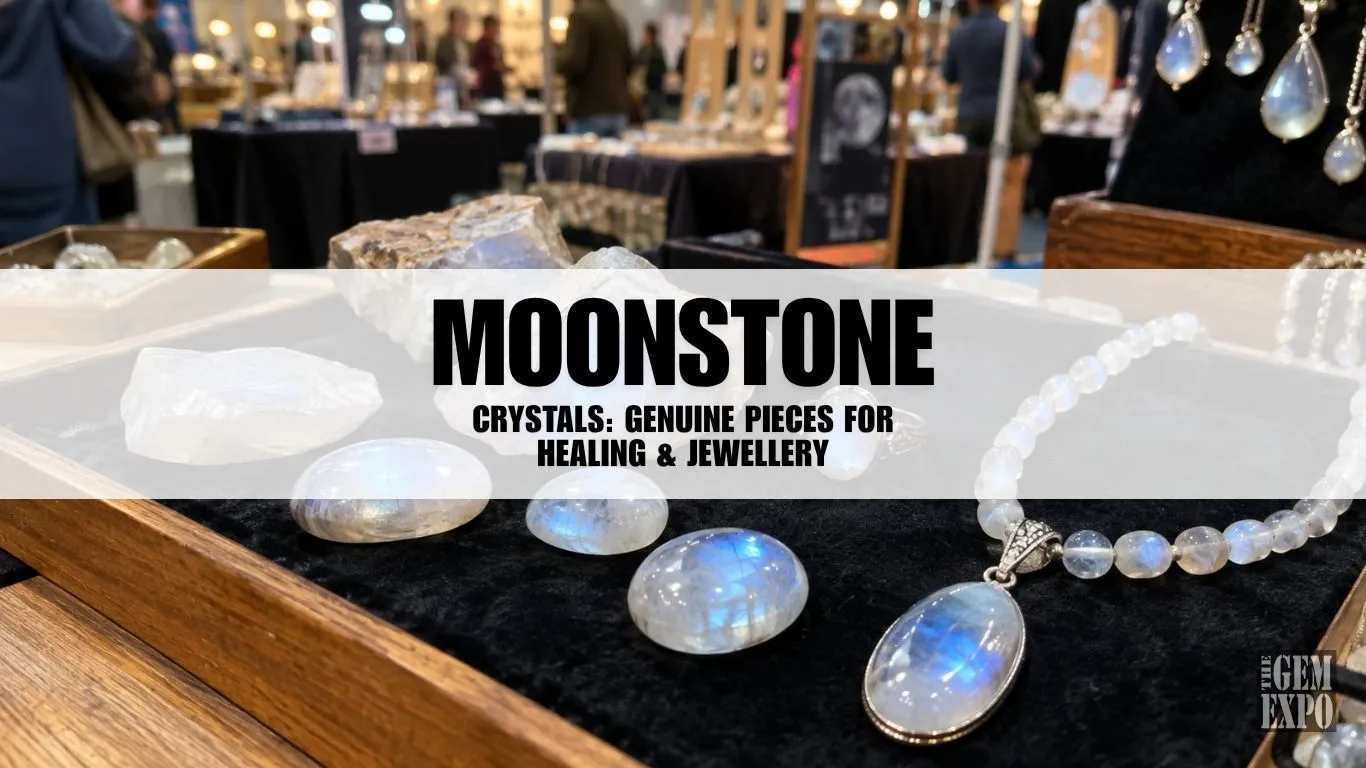

A woman stood at a vendor’s table at last spring’s show, turning a small cabochon over in her palm. She wasn’t really looking at it so much as waiting for it. Then it happened: a soft blue light rolled across the surface like moonlight on water, and she laughed out loud. That little flash is the whole reason moonstone crystals have been collected, worn and gifted for thousands of years. If you have ever wondered why this pale, unassuming stone earns such devotion, the answer is sitting right there under the surface.
If you’d like to see that glow in person before buying anything, mark your calendar now. The next Gem Expo runs November 27 to 29, 2026, at the Hyatt Regency Toronto, and dozens of vendors will bring their own hand-picked moonstone crystals, along with raw specimens, beads and finished jewellery. Watching the shimmer move under a table lamp is a very different experience than scrolling past a product photo online.
What Are Moonstone Crystals, Really?
Despite the name, moonstone crystals are not made of moon rock, and nothing about their origin is quite that dramatic. They belong to the feldspar family, one of the most common mineral groups on earth, and get their glow from thin layers of two different feldspar minerals stacked inside the stone. When light hits those layers, it scatters and appears to float just beneath the surface. Gemologists call this effect adularescence, and it’s the one feature that separates real moonstone from a look-alike piece of glass or resin.
Because feldspar forms in so many places, moonstone turns up in India, Sri Lanka, Madagascar, Myanmar and even parts of Canada’s own mineral-rich regions. India in particular supplies a large share of the material sold across North America, which is why so many vendors at gem shows carry pieces sourced directly from Indian mines.
If you enjoy this kind of detail, our gemstone blog covers dozens of other stones in the same depth, from birthstones to rare collector finds.
The Many Colours of Moonstone: Grey, White, Blue and Rainbow
One reason moonstone crystals feel so collectible is that no two pieces glow quite the same way. The colour moonstone you end up drawn to often says something about the mood you’re after, whether that’s calm and grounding or bright and eye-catching. Here’s a quick side-by-side look at the main varieties buyers ask about most:
| Type | Typical Look | Common Use |
|---|---|---|
| White moonstone gemstone | Milky white body with a soft silver or blue flash | Everyday rings and beaded bracelets |
| Grey moonstone gemstone | Smoky grey base with a gentle, quiet shimmer | Meditation stones, pocket carry pieces |
| Blue moonstone gem | Nearly colourless with a strong, electric blue sheen | High-end rings and pendants |
| Rainbow moonstone stone | Clear to milky body with multicoloured flashes | Statement necklaces and earrings |
A grey moonstone gemstone tends to suit people who want something understated for daily wear, while a blue moonstone gem is usually the piece collectors chase for its intensity. Worth knowing too: what the trade calls a rainbow moonstone stone is technically a variety of labradorite rather than true moonstone, though the effect is close enough that most buyers treat it as part of the same family. Our guide to labradorite crystal breaks that connection down if you want the full picture, and it’s a useful read before choosing a colour moonstone for a specific piece of jewellery.
Why People Reach for a Moonstone Gem
Ask ten different people why they keep a moonstone gem on their nightstand or tucked in a bag, and you’ll likely get ten different answers. Some see it as a stone for new beginnings, tied for centuries to lunar cycles and the idea of gentle change. Others use it during meditation, resting it near the third eye chakra to support quiet reflection. It’s also a common pick for anyone who feels scattered or overstimulated, since the stone’s soft glow is often described as calming rather than energising.
None of this is medical or psychological advice, and moonstone should never replace proper care from a qualified professional. What can be said with more confidence is that the simple ritual of holding a smooth, cool stone and watching it catch the light has a genuinely settling effect on plenty of people, whatever the actual mechanism behind it turns out to be.
Moonstone Jewellery: Rings, Pendants and Necklaces
This is where the stone really earns its keep. A moonstone gemstone ring catches light with almost every hand movement, and a moonstone gemstone necklace layered with smaller beads works just as well for everyday wear, which is exactly why moonstone rings tend to sell out fast at jewellery tables. A single moonstone pendant on a thin chain sits close to the collarbone and lets the glow show off without much distraction, while a fuller moonstone gemstone necklace, built from graduated beads, gives a lot more surface area to catch the sheen as you walk.
Whether you think of them as moonstone jewels or moonstone jewellery, most Canadian buyers want to try a piece on before committing, turning it under a few different light sources to watch how the shimmer behaves. A second moonstone pendant might catch a warmer flash than the first, and no two moonstone rings from the same tray will glow identically. That’s honestly the best way to shop for a moonstone necklace or moonstone gemstone ring: in person, under changing light, rather than from a single still photo. If you’d like to browse pieces from independent makers who specialise in this kind of wearable stone, our meet the vendors page lists artisans bringing rings, pendants and necklaces to the next show.
How to Tell a Genuine Moonstone from a Fake
Because moonstone crystals are affordable compared to gems like sapphire or diamond, they don’t get faked as often as pricier stones, but glass and plastic imitations do turn up online. A short, step-by-step check can save you from an unpleasant surprise:
- Look for movement, not just shine. Real moonstone shows a glow that seems to float and shift as you tilt it. Glass usually just reflects light from one fixed spot.
- Check the temperature. Natural stone feels cool to the touch for a moment before warming up. Plastic warms almost instantly.
- Examine the surface under magnification. Genuine feldspar often shows faint internal layering or tiny inclusions. Glass tends to look perfectly uniform.
- Ask about origin. A seller who can tell you whether the piece is from India, Sri Lanka or Madagascar is usually working with real material and has done their homework.
- Compare weight. Moonstone is denser than most glass imitations of a similar size, so a piece that feels unusually light is worth a second look. This matters especially for rings set in metal, since a lightweight setting can hide a lightweight stone.
For a more technical breakdown of colour, clarity and cut grading, the Gemological Institute of America’s moonstone buying guide is a solid outside reference.
We walk through similar authenticity checks in our own guide to spotting real versus fake ametrine, since comparing weight, temperature and internal structure works across most coloured gemstones, not just one.
Caring for Your Moonstone Crystals
Like most feldspar gems, moonstone sits around a 6 to 6.5 on the Mohs hardness scale, which means it scratches more easily than diamond or sapphire. Store pieces separately from harder stones, avoid wearing moonstone rings during workouts or manual work, and clean with a soft cloth and mild soap rather than an ultrasonic cleaner, which can worsen existing internal fractures. Our care guide for aquamarine covers a lot of the same gentle cleaning principles, since both stones are softer and more prone to damage from harsh chemicals than most people expect.
Pairing Moonstone with Other Crystals
Collectors often build a small grid or shelf display around their favourite pieces, and a few pairings come up again and again. Amethyst is a favourite partner for anyone using stones during meditation, since its purple tone is thought to complement moonstone’s quieter energy.
Citrine gets paired in for a brighter, more optimistic combination, and its warm tone plays well against moonstone’s cooler glow.
Lapis lazuli often joins the mix too, especially for people focused on intuition and clear thinking. None of these pairings are required, of course. Plenty of people simply like the way a pale crystal moon stone looks sitting next to a deeper blue or purple piece on a windowsill, and a crystal moon stone tucked among darker minerals tends to stand out even more.
FAQs
Is moonstone a birthstone?
Yes. Moonstone shares the June birthstone spot with pearl and alexandrite. It's one of the few birthstones that isn't a single mineral species, since any adularescent feldspar can qualify as moonstone regardless of its exact chemical makeup.
How much does moonstone cost?
Moonstone is one of the more affordable gemstones, which is part of why it's popular for everyday jewellery. Small tumbled or beaded pieces can run just a few dollars, while faceted stones with a strong, colourless body and vivid blue sheen command the highest prices, sometimes reaching a few hundred dollars per carat for top quality.
Can you wear moonstone in the shower or while you sleep?
It's best to take moonstone off before showering or swimming. It sits at a 6 to 6.5 on the Mohs hardness scale and has perfect cleavage, so soap residue, chlorine, and repeated water exposure can dull its shine or cause internal fractures over time. Wearing it to sleep as a pendant or ring is generally fine, since the risk comes from moisture and impact rather than gentle everyday contact.
What zodiac sign is moonstone associated with?
Moonstone is most commonly linked to Cancer, since the sign is ruled by the moon in Western astrology. Some traditions also connect it to Libra and Scorpio, though Cancer remains the most widely cited association across astrology and crystal communities.
Is moonstone a rare gemstone?
Moonstone itself isn't rare, since feldspar is one of the most abundant mineral groups on earth. What's rare is top-quality material: a colourless, transparent stone with a strong, evenly distributed blue sheen and no visible inclusions. That combination is unusual enough that it drives most of the price difference between a basic tumbled stone and a fine faceted one.
Where to See and Buy Genuine Moonstone Crystals in Canada
Buying a gemstone from a screen works fine when you already know exactly what you want. But for something as visually dependent as moonstone, seeing it move under real light changes everything, and that’s really the whole point of an in-person gem show. At The Gem Expo, verified vendors bring in moonstone alongside dozens of other crystals, minerals and handcrafted jewellery pieces, so you can compare several stones side by side before deciding which moonstone gem actually earns a spot in your collection.
If you have questions about a specific piece, sourcing, or which vendor to look for at the next show, our team is easy to reach through the contact us page.
And if you’re the kind of person who plans ahead, our show hours and dates page has everything you need to build a visit around the exact times each vendor will be set up.
Whether you end up with a soft grey moonstone gemstone for quiet reflection, a classic white moonstone gemstone for everyday wear, a striking blue moonstone gem for a special occasion, or a full moonstone necklace strung with rainbow beads, the stone tends to find its way into daily use fast. That’s the real appeal of moonstone jewellery: it’s beautiful enough to notice, subtle enough to wear every day, and made up of moonstone jewels that genuinely look different every time the light catches them.