
My grandmother had a small string of pearls she wore only twice a year. As a kid, I thought they were just white beads. Years later, a jeweller told her they were not beads at all. They were real, grown inside a wild oyster with no human help involved. That single sentence changed how our whole family looked at that necklace sitting in a drawer. That is the same feeling most people get when they first learn what a natural pearl actually is. It is rare, it is old, and almost nobody sees one up close anymore. If you are curious about how this gem forms, how it differs from the cultured pearls sold in most stores, and where you can actually see and hold one in Canada, this guide walks you through it in plain, simple language.
If you want to see real pearls and handcrafted gemstone pieces in person rather than on a screen, come visit us at an upcoming Gem Expo. The dates and details are near the end of this guide, so keep reading.
What Makes a Natural Pearl So Rare
This type of pearl forms by pure accident. A tiny piece of sand, a parasite, or some other irritant slips inside a mollusk, usually an oyster or a mussel. The animal cannot push it out, so it protects itself the only way it knows how. It coats the irritant, layer after layer, in a smooth material called nacre. Over months and years, those layers build up until a pearl is formed.
No person plants anything inside the shell. Nothing is guided or planned. That is the whole point. Out of roughly ten thousand wild oysters, only one is likely to produce a pearl worth using in jewellery. This is why gemstone jewellery made from a genuine wild pearl tends to carry a much higher price than the cultured pearl jewellery found in most malls.
Natural Pearl vs Cultured Pearl: What Is the Difference
This is the question almost every visitor asks our vendors at the show. Both types are real pearls made of nacre, so the difference is not about which one is fake. It comes down to how the process started.
| Feature | Natural Pearl | Cultured Pearl |
|---|---|---|
| How it forms | By accident, no human involvement | A technician inserts a bead or tissue to start the process |
| Rarity | Extremely rare, mostly antique | Common, farmed in large numbers |
| Typical source | Wild oysters and mussels | Pearl farms worldwide |
| Shape | Often irregular or baroque | Usually round and uniform |
| Price | High, often auction level | Affordable to mid range |
According to the Gemological Institute of America, wild pearls and cultured pearls are chemically almost identical, since both are made of nacre by a living mollusk. The main difference GIA points to is the role human hands played at the very start of the process.
How a Natural Pearl Actually Forms, Step by Step
It helps to picture this as a slow, quiet event happening inside a shell on the ocean floor.
- An irritant enters the shell. A grain of sand, a small parasite, or a bit of shell debris gets inside the soft tissue of the mollusk.
- The mollusk reacts. It cannot remove the object, so its body treats it as a threat that needs to be sealed away.
- Nacre begins to form. Thin layers of nacre, the same shiny substance that lines the inside of the shell, wrap around the irritant.
- Layers build over time. This can take several years, with each layer adding a small amount of thickness and lustre.
- The pearl is eventually found. A diver or fisherman opens the shell, often after searching through thousands of others, and finds the finished gem.
There is no shortcut in that list. That patience is exactly why this rare gem feels different once the story behind it is understood.
Pearls Come in More Varieties Than People Expect
Freshwater pearls, Akoya pearls, Tahitian pearls, and South Sea pearls are the names heard most often at any gem show. Freshwater pearls tend to grow in rivers and lakes and often come in soft, uneven shapes. Akoya pearls are known for their bright white colour and mirror like shine.
Tahitian pearls, on the other hand, grow in darker shades of grey, green, and even black. They carry a rich past, and the full story behind Tahitian pearls is worth a read if you want to know how French Polynesian farmers first began cultivating them.
Most jewellery seen today, including a classic pearl necklace, uses cultured versions of these varieties. A genuine wild pearl is treated as its own separate category, closer to a rare gemstone than a farmed product.
How to Spot a Genuine Pearl Before You Buy
A lab is not needed for a basic check. Try these steps before buying any pearl jewellery.
- Feel the temperature. Real pearls feel cool against skin for the first few seconds. Plastic imitations warm up almost instantly.
- Check for tiny imperfections. A perfectly smooth, perfectly round pearl is more likely to be fake. Genuine pearls usually show small natural variations.
- Look at the surface under light. Real nacre reflects light in a soft, layered glow rather than one flat shine.
- Ask for documentation. Any seller offering a true natural pearl should be able to show a gemological certificate, since claims like this are usually verified by a lab.
- Gently rub two pearls together. Genuine pearls often feel slightly gritty, while glass or plastic beads slide smoothly against each other.
If a seller cannot answer basic questions about where a piece came from, that alone is reason enough to slow down before buying any gemstone jewellery.
Caring for Pearl Jewellery So It Lasts
Pearls are softer than most gemstones, so they need gentler care than a diamond ring or a lapis lazuli pendant. Perfume, hairspray, and sweat can slowly wear down the nacre if pearls are worn carelessly.
Put pearls on last, after makeup and perfume, and take them off first at the end of the day. A soft cloth and a light wipe after each wear is usually enough. Harsh chemicals and ultrasonic cleaners should be avoided completely, since they can strip away layers that took years to form.
Why Visit The Gem Expo for Natural Pearl Jewellery
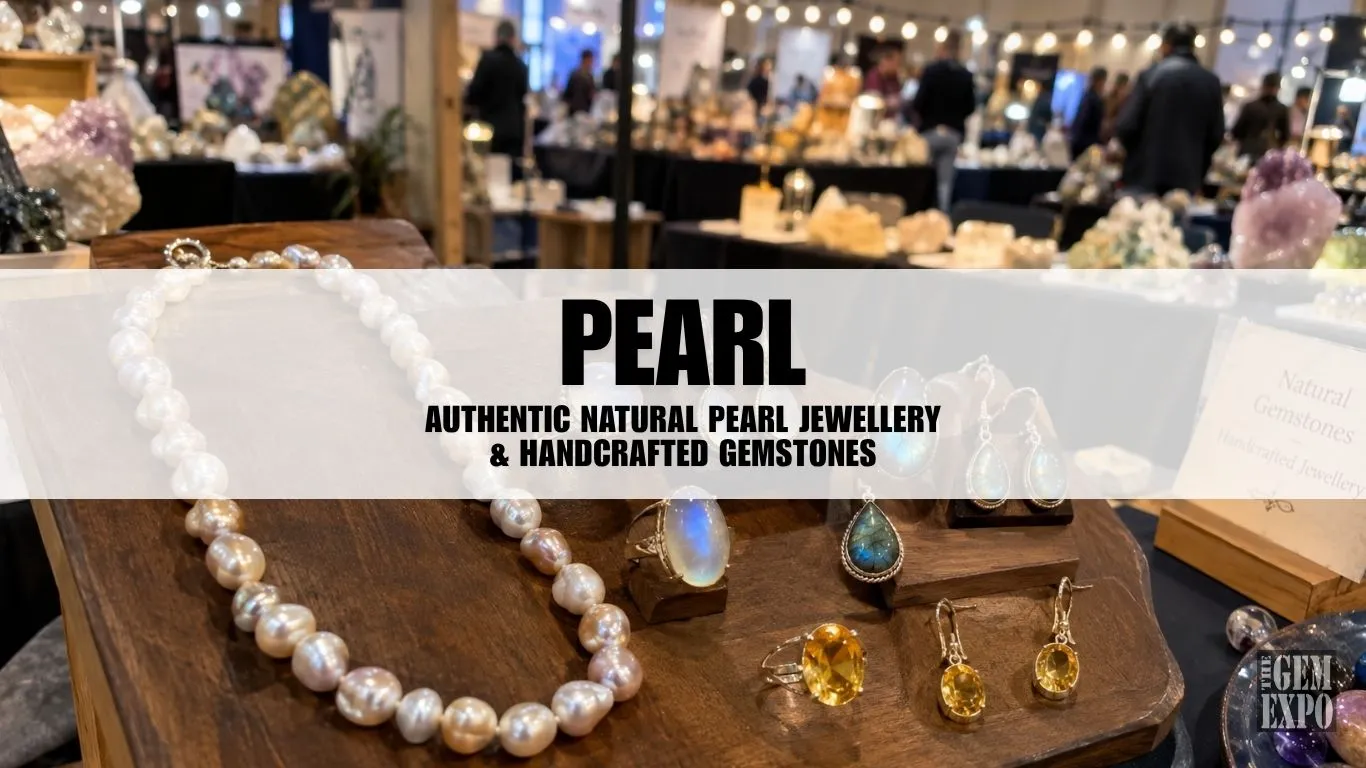
Reading about a natural pearl is one thing. Holding one, turning it under the light, and comparing it beside a citrine ring is a different experience entirely. At The Gem Expo, independent vendors bring in pearls alongside other gemstone favourites, so textures, colours, and prices can be compared side by side in one afternoon instead of hopping between websites.
One long time vendor at our show, Natural Gems Canada, specialises in pearl pieces reviewed by a professional gemologist, which makes it a solid stop if certification matters to a buyer.
Beyond pearls, the show floor also features artisans working with moonstone, which pairs beautifully with a pearl setting.
Fans of colourful stones often stop to admire labradorite for its flash of blue and green.
A hand-strung jade bead necklace is another popular pick, usually sitting just a few tables away from the pearl vendors.
Those who prefer cooler tones tend to gravitate toward aquamarine, which shares a soft, watery colour palette with many freshwater and Akoya pearls.
Our gemstone blog covers many of these stones in more depth, for anyone who wants extra reading before the show.
A full amber guide is also available for visitors curious about that gem too.
This is also a friendly place to bring questions. Vendors expect them, and most are happy to explain the difference between a wild pearl and a cultured one right at their table, using the actual pieces in front of them as examples.
FAQs
How much is a genuine natural pearl worth?
Prices vary widely based on size, shape, and origin. A small natural pearl can start around $500, while larger, high-quality specimens with strong lustre and minimal blemishes have sold for tens of thousands of dollars. Matched natural pearl strands are rarer still and have reached auction prices in the millions. A professional appraisal is the only reliable way to know an exact value.
Can you still find natural pearls today, or are they only in antique jewellery?
Natural pearls are almost never harvested commercially anymore. Overfishing in the late 1800s and early 1900s wiped out most wild pearl beds, and cultured pearl farming has since taken over the market. Today, the vast majority of natural pearls in circulation come from antique jewellery, estate sales, or auction houses rather than fresh harvests.
Is a natural pearl a good investment?
Natural pearls can hold or gain value over time, especially rare colours, larger sizes, and pieces with documented origin from a recognised lab. However, they are not a liquid investment like gold or stocks, and value depends heavily on quality and buyer demand. Anyone buying primarily for investment should get a certified appraisal before purchasing.
What is the rarest type of natural pearl?
Conch pearls and melo pearls rank among the rarest, since they form in specific mollusks rather than common pearl oysters. Conch pearls, found mainly in the Caribbean, occur in roughly one out of every ten thousand conch shells collected, and their salmon pink tones can command prices well over $100,000 per strand.
Is a natural pearl the official June birthstone, or only cultured ones count?
Pearls, in general, are recognised as the traditional June birthstone, and this includes both natural and cultured varieties. A natural pearl carries the same birthstone meaning as a cultured one, though jewellers most often use cultured pearls for birthstone jewellery simply because natural ones are too rare and costly for everyday pieces.
Plan Your Visit
The next Gem Expo runs from November 27 to 29, 2026, at the Hyatt Regency in downtown Toronto. Friday hours are 11:30am to 8pm, Saturday runs 11am to 7pm, and Sunday closes at 6pm.
Whether the goal is a genuine wild pearl piece, a handcrafted gemstone gift, or simply an afternoon out browsing something real instead of scrolling a feed, this show is built for exactly that. Come see the pearls, minerals, and handmade jewellery in person, ask the vendors questions directly, and pick out something that means more than a quick online order ever could.