
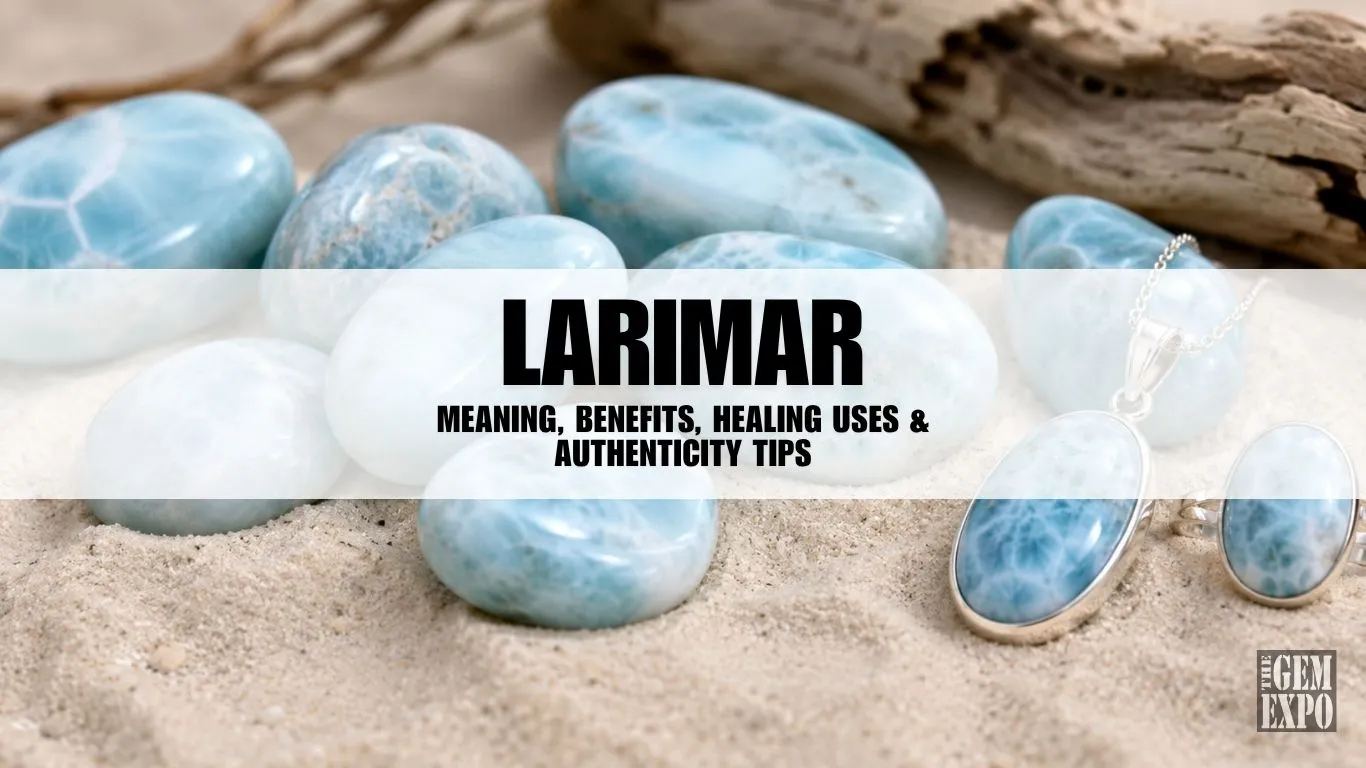

The first time most people see Larimar, they stop mid sentence. It looks like a piece of the Caribbean Sea was frozen and polished into a stone. That reaction is not an accident. This rare blue gem is found in only one place on Earth, and once you know its story, it is hard to look at it the same way again.
If you have ever searched for a larimar stone online, you already know it is not sold everywhere. Genuine pieces are limited, prices vary widely, and fakes are common. This article breaks down what larimar actually is, what it is believed to do for the mind and body, and how to check if the piece in front of you is real. You can also see authentic pieces in person at The Gem Expo, Toronto’s own gem and jewellery show, where verified vendors bring genuine stones straight to the public. Check the next show dates here before you plan your visit.
What Is Larimar, Exactly?
Larimar is not its own mineral. It is a rare blue variety of a mineral called pectolite. Pectolite itself is common and found in many countries, but the sky blue version, the one people actually call Larimar, comes from a single mountain range in the Dominican Republic. Nowhere else on the planet produces this exact colour combination of ocean blue and white.
The blue tone comes from tiny traces of copper trapped inside the stone as it formed millions of years ago inside old volcanic rock. According to the International Gem Society, this is why the coloring is considered a true rarity in the gem trade rather than a marketing label. That single detail is the reason a genuine Dominican Republic gemstone like this one holds real value while lookalikes made from dyed stone do not.
The Story Behind This Dominican Republic Stone Larimar
Every gemstone has a history, but this one has a sweeter story than most. In 1974, a Peace Corps volunteer and a local resident rediscovered deposits of the stone that had been mostly forgotten for decades. The stone was named by combining part of the resident’s daughter’s name, Larissa, with “mar,” the Spanish word for sea. That is where the name Larimar comes from, and it fits perfectly, since the pattern inside each piece really does look like waves rolling across a beach.
Locals in the Dominican Republic sometimes pair it with another regional treasure, amber, when selling handmade jewellery to tourists. The combination of amber and larimar Dominican Republic pieces has become something of a tradition there, one warm and golden, the other cool and blue, almost like sun and sea sitting side by side on the same bracelet.
If you enjoy stories like this behind the stones you wear, our aquamarine gemstone guide covers a similarly ocean-toned gem with its own centuries-old legend.
What Larimar Is Believed to Mean
In crystal healing circles, Larimar is often called the Stone of Serenity, and sometimes the Dolphin Stone or the Atlantis Stone. None of these names are ancient. They were given by modern collectors, but the meaning behind them has stuck for a reason.
People who work with this larimar gemstone commonly associate it with:
- Calmness during stressful moments
- Clearer, more honest communication
- A sense of connection to water and emotional release
- Balance between the heart and the throat chakra
It is worth saying plainly, this is a matter of personal belief and tradition rather than scientific proof. Still, many people report feeling calmer simply by holding or wearing the stone, and that alone explains why it has become a favourite among meditation practitioners.
Larimar Benefits and How People Use It
Most people who buy this stone are not looking for an investment piece. They are looking for something they can hold onto during a hard week. If you want to try using it yourself, here is a simple approach many collectors follow:
- Choose your piece. A pendant or ring works well for daily wear, while a raw palm stone is better for meditation.
- Hold it during quiet moments. Five minutes of stillness while holding it is enough for most people to notice a shift in mood.
- Wear it near the throat. Necklaces are popular because the stone is thought to support the throat chakra, tied to communication.
- Set an intention. Many practitioners simply say a short phrase in their head, like “I choose calm,” while holding the stone.
- Clean it gently after use. More on that below, since this stone needs a soft touch.
A woman at one of our Toronto shows once told a vendor she wears her larimar pendant to every job interview because it stops her hands from shaking. Whether that is the stone or simply the comfort of a familiar object in her pocket, the effect for her is real either way.
Larimar Compared to Other Blue Gemstones
Since blue stones often get confused with one another, here is a quick side-by-side look.
| Stone | Origin | Hardness | Common Use |
|---|---|---|---|
| Larimar | Dominican Republic only | 4.5–5 (soft) | Pendants, earrings |
| Turquoise | Multiple countries | 5–6 | Rings, bracelets |
| Aquamarine | Brazil, Africa, others | 7.5–8 | Rings, everyday wear |
| Blue Chalcedony | Multiple countries | 6.5–7 | Beads, statement jewellery |
As the table shows, this gem is one of the softer options on the list, which explains why most designers avoid setting it into rings meant for daily wear and hard use.
Larimar Jewellery: Rings, Pendants, and Little Larimar Pieces
When shopping for larimar jewellery rings, keep the hardness in mind. Because the stone scratches easily, well-made rings usually protect it with a raised bezel setting rather than an open claw. Pendants and drop earrings are the safer, more popular choice since they see less daily contact.
You do not need a large piece to enjoy this stone. Even a little larimar bead on a bracelet, paired with sterling silver, carries the same calming blue pattern as a large statement pendant. Many first-time buyers actually start small before working up to a bigger piece once they know they love the colour.
If you are building a small collection of meaningful stones, our chrysoprase article and hematite benefits piece both make excellent companion reads, since collectors often pair calming blues with grounding stones for balance.
How to Spot Genuine Larimar: Authenticity Tips
This is the part most buyers skip, and it is exactly where they get burned. Since only one mine in the world produces this stone, and demand is high, fakes are unfortunately common online. Follow these steps before buying:
- Look at the pattern. Real stones show natural white veining and circular patterns that look organic, not printed.
- Check the price. If a large pendant is priced far below market average, that is a warning sign.
- Ask about origin. A trustworthy seller will confirm the piece came from the Dominican Republic and can usually explain how they sourced it.
- Feel the weight and texture. Dyed howlite, a common fake, feels lighter and the colour often looks too uniform.
- Buy from vendors you can question directly. This is where shopping in person has a real advantage over a random online listing.
That last point is exactly why events like The Gem Expo matter. Rather than guessing from a photo, you can pick up the piece, ask the vendor questions, and compare several stones side by side before deciding. Our azurite crystal guide covers similar identification tips for another commonly faked blue stone, and the blue kyanite crystal guide does the same for a Canadian favourite.
Caring for Your Larimar
Because of its softness, this stone should be treated gently.
- Avoid soaking it in water for long periods
- Keep it away from harsh chemicals and perfume
- Store it separately from harder stones like quartz or topaz to prevent scratching
- Clean with a soft, slightly damp cloth only
Treated well, a piece can stay in a family for generations, passed down the way a good story usually is.
FAQs
How much does genuine Larimar cost?
Prices vary based on colour depth and size. Light blue pieces with heavy white veining start around $30 to $80 CAD for small pendants. Deep, saturated "AAA grade" Larimar with strong blue tones and minimal white can run $150 to $500 CAD or more per piece, since that colour intensity is rare even within Dominican Republic mines.
Is Larimar linked to a birthstone or zodiac sign?
Larimar is not an official birthstone, but many crystal practitioners connect it to Pisces because of its water-like colour and calming nature. It is also sometimes recommended for Aquarius, given the shared association with communication and emotional flow.
Can you wear Larimar in the shower or pool?
No, this should be avoided. Larimar is a soft stone, and chlorine, salt water, and soap residue can dull its polish over time. Always remove Larimar jewellery before swimming, showering, or washing dishes to keep the surface clear and glossy.
Why is Larimar priced higher than similar-looking blue stones?
Supply is the main reason. Larimar comes from a single mine in the Dominican Republic, and that mine has a limited yield each year. Stones like blue chalcedony or dyed howlite are mined in multiple countries in much larger quantities, which keeps their prices lower by comparison.
Does Larimar's colour fade over time?
Yes, prolonged direct sunlight can gradually lighten the blue tone in lower-quality stones. This is more noticeable in pale specimens than in deep blue, high-grade pieces. Storing jewellery away from direct sun when not worn helps preserve the original colour for years.
See Genuine Larimar in Person
Reading about a stone only goes so far. The colour, the pattern, and the calm feeling people describe are things you really have to experience firsthand. The Gem Expo brings trusted, verified vendors together three times a year at the Hyatt Regency in downtown Toronto, so you can see authentic pieces, ask questions, and shop with confidence instead of guessing from a screen.
Our next show runs November 27 to 29, and it is the easiest way to hold a real piece of this Dominican Republic gemstone in your own hands before you buy. Reserve your tickets and see the full show schedule here, and browse our vendor directory to see who will be bringing authentic gemstone jewellery this year.