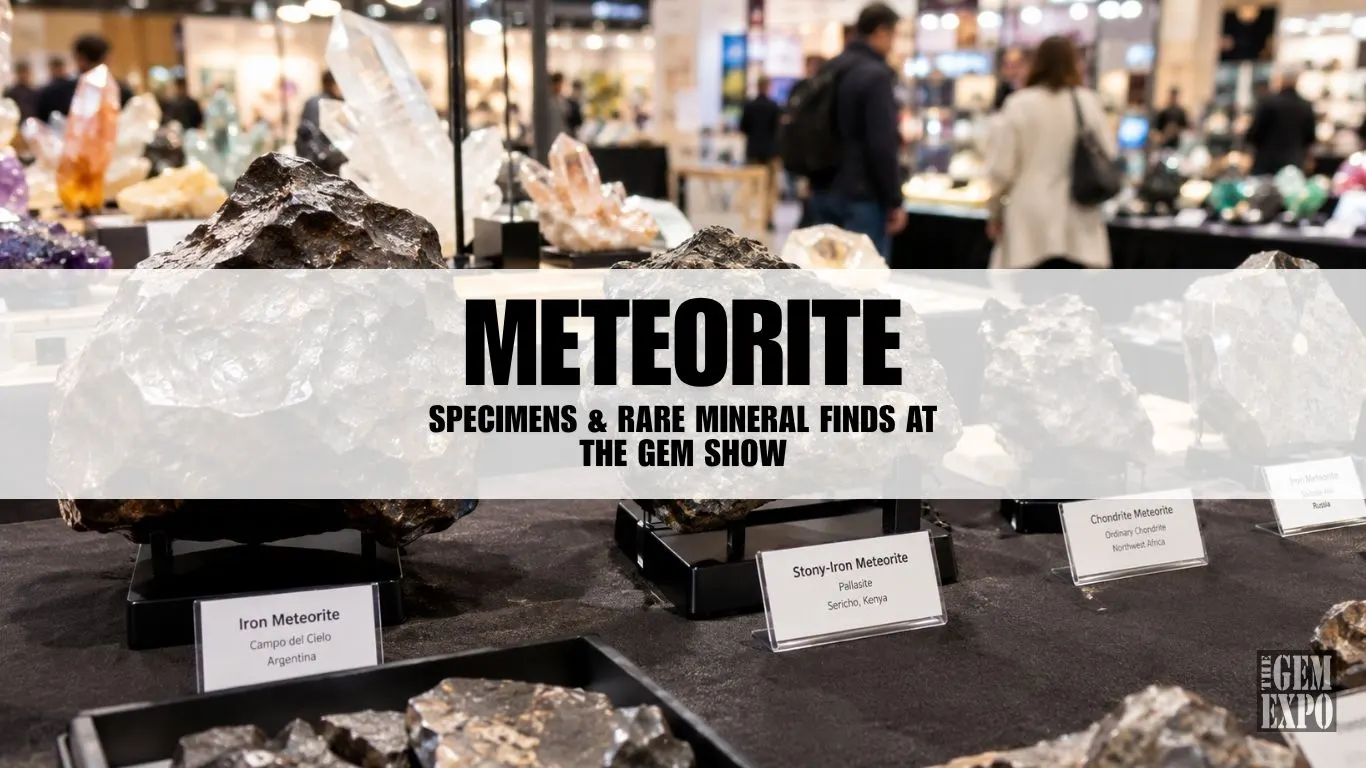

Hold something older than the Earth itself in the palm of your hand, and something changes. That is exactly what happens when a visitor picks up a genuine meteorite for the first time at a mineral show table. It feels heavier than expected. It looks nothing like the rocks found in a backyard or a riverbed. And once someone learns where this space rock actually came from, it is hard to put back down. This is why authentic space rocks have quietly become one of the most talked-about finds at gem and mineral shows across Canada, and why so many collectors, families, and first-time buyers now search for a rare specimen display before they even step through the door.
Want to see one before you read any further? The Gem Expo brings real extraterrestrial specimens, rare mineral finds, and crystals together under one roof, and there is no better way to understand them than holding one in person.
If you have ever wondered what a real meteorite is, how to tell one apart from an ordinary rock, or why some specimens cost more than others, this guide walks through it all in plain, simple language. No science degree is needed.
What Exactly Is a Meteorite?
A meteorite begins its journey far from Earth, usually as a small piece of an asteroid, and occasionally as a fragment of the Moon or Mars. While it travels through space, it is called a meteoroid. Once it enters Earth’s atmosphere and burns brightly across the sky, it is seen as a meteor, often nicknamed a shooting star. If any part of that space rock survives the fiery fall and reaches the ground, it earns a brand new name.
This difference trips a lot of people up, so here is a simple breakdown:
| Stage | What It’s Called | Where It Is |
|---|---|---|
| Traveling through space | Meteoroid | Outer space |
| Burning through the sky | Meteor | Earth’s atmosphere |
| Landed on the ground | Meteorite | Earth’s surface |
Once a space rock is confirmed and classified, it is studied and, in many cases, sold to collectors, museums, and mineral enthusiasts who want a real piece of the solar system sitting on a shelf at home.
The Main Types Collectors Look For
Not every fallen space rock looks the same, and that variety is part of what makes collecting them so interesting. Broadly, these finds are grouped into three families:
- Iron specimens are made mostly of nickel and iron. They are heavy, magnetic, and often have a smooth, metallic surface once cut and polished.
- Stony specimens are the most common type found on Earth and are made largely of silicate minerals, with a dark fusion crust formed by atmospheric heat during the fall.
- Stony-iron specimens, including the visually striking pallasites, blend both metal and mineral in a single piece, often showing olive-green crystals scattered throughout.
Booths run by sellers such as Crystal Palace Gems & Minerals usually carry a mix of all three, giving newer collectors a chance to feel the weight difference between an iron piece and a stony one before deciding what to buy.
How to Spot an Authentic Meteorite Specimen
Because a genuine meteorite can fetch a high price, and because fakes do circulate online, learning to check for authenticity matters. Here is a simple step-by-step approach that even a beginner can follow at a show table:
- Ask for a certificate of authenticity. A trusted seller should provide documentation naming the specimen’s classification and origin.
- Look at the fusion crust. Genuine pieces often show a dark, slightly glassy coating formed during the fiery trip through the atmosphere.
- Test with a magnet. Most confirmed space rocks, especially iron ones, will react to a magnet because of their metal content.
- Compare weight to size. A real specimen is usually denser than an ordinary rock of a similar size.
- Ask the vendor questions. Reputable sellers, like the specialists at A Mineral Affair, are typically happy to explain where a piece was found and how it was verified.
This kind of hands-on checking is something an online marketplace simply cannot offer, which is one reason serious collectors still prefer shopping in person.
A Collector’s First Find
One returning visitor once described walking past a modest folding table expecting nothing more than polished stones, only to be handed a small, dark, surprisingly heavy fragment and told it had likely fallen to Earth thousands of years before recorded history began. That fragment now sits on a windowsill at home, and it started what has become an ongoing hobby of hunting down rare specimen booths, such as Atlas Trove, at every show since. Stories like this are common. A single genuine find in hand tends to turn a casual visitor into a lifelong collector of space rocks and rare minerals alike.
If a story like that sounds appealing, the next step is simple: come see the specimens for yourself and talk to the people who source them.
Beyond Raw Specimens: Meteorite Jewellery and Uses
Real meteorite fragments are not only displayed as raw pieces. Slices are increasingly set into rings, pendants, and cufflinks by artisans working with unusual materials. Jewellery makers such as Enchanté Jewellery sometimes incorporate these slices alongside gemstones, giving buyers a piece that is wearable and genuinely out of this world. These crossover pieces have become a popular gift for space enthusiasts, science teachers, and anyone drawn to rare mineral finds with a story behind them.
Other Rare Mineral Finds Worth a Look
A show built around space rocks naturally attracts collectors of other rare mineral specimens too. Crystal healers and hobbyists often stop by Serenity Stones for polished stones sourced from around the world.
Those chasing raw, earth-formed pieces instead tend to gravitate toward Element Earth, where specimens pair naturally with a small collection of extraterrestrial finds.
Canada Has Its Own Meteorite History
Canada is home to several documented falls that collectors and researchers still study today. The Tagish Lake meteorite, which fell in 2000 near the Yukon-BC border, is prized for preserving material believed to predate our solar system. The Whitecourt find in Alberta and the Buzzard Coulee find in Saskatchewan are two more well-known Canadian specimens that regularly come up in collector conversations. According to the Meteoritical Society, an internationally recognized authority on classification, every confirmed fall or find is logged in an official database, which is part of why buyers are encouraged to ask for documentation before purchasing.
Reading more Canadian mineral stories on the gemstone blog is a good next step for anyone who wants the deeper history behind the rocks on display.
Why Visit in Person Instead of Buying Online
Photos online cannot show true weight, magnetism, or the small surface details that separate an authentic meteorite from a convincing fake. Seeing a specimen under proper lighting, holding it, and speaking directly with a knowledgeable seller remains the most reliable way to buy with confidence. Dozens of vendors bring space rocks, minerals, and crystals to compare side by side in one afternoon, something no single online listing can replicate. Browsing the full vendor lineup ahead of time helps visitors plan which booths to prioritize once inside.
FAQs
Is it legal to own a meteorite in Canada?
Yes, meteorites found or purchased legally can generally be owned as personal property in Canada, since they are treated as natural mineral specimens rather than protected artifacts. That said, meteorites found on someone else's land, in a national park, or in a protected area may fall under separate land or heritage rules, so it's worth checking the specific find location before assuming ownership. Buying from an established vendor with documented origin avoids this issue entirely.
How much do meteorite specimens typically cost?
Pricing depends mainly on type, rarity, and size. Common stony chondrites can start as low as a few dollars per gram, while rarer pallasites, lunar, or Martian meteorites can sell for hundreds or even thousands of dollars per gram due to their scarcity. Fusion crust condition, documented fall history, and certification also affect price, which is why two similarly sized pieces can vary widely in cost.
Are meteorites radioactive or dangerous to touch?
No. Meteorites are not radioactive and are safe to hold, display, or handle without any special precautions. They also do not carry disease or contamination risk. The only practical care point is that iron meteorites can rust slightly if handled with wet or oily hands, so keeping them dry and lightly oiled for long-term storage is recommended.
Do meteorites hold long-term value as a collectible or investment?
Meteorites are considered a finite resource since no new material is being created, which supports long-term collector demand. However, like any collectible, value depends on rarity, documentation, and market interest rather than guaranteed appreciation. Buyers looking at meteorites as an investment should treat them primarily as a passion purchase first, with resale value as a secondary factor.
How should a meteorite specimen be stored or cared for at home?
Most meteorites can simply be displayed on a shelf or in a display case without special equipment. Iron and stony-iron specimens benefit from being kept in a dry environment and occasionally wiped with a light coat of mineral oil to prevent surface rust. Stony specimens are more stable and mainly need to be kept away from excess moisture and handled carefully, since some can be more brittle than they appear.
Plan Your Visit
The Gem Expo returns to the Hyatt Regency in downtown Toronto from November 27 to 29, with rare specimens, minerals, crystals, and handcrafted jewellery from trusted vendors across Canada and beyond. Doors open Friday at 11:30 a.m., Saturday at 11:00 a.m., and Sunday at 11:00 a.m. Checking the show hours and future dates page before arriving helps visitors plan around talks, workshops, and vendor hours.
Whether the goal is starting a collection, adding a rare stony-iron piece to an existing one, or simply seeing a real meteorite up close for the first time, this remains one of the few places in Canada where dozens of verified sellers gather under one roof. Anyone ready to plan a visit or ask about a specific specimen can reach the team through the contact page before doors open on November 27.