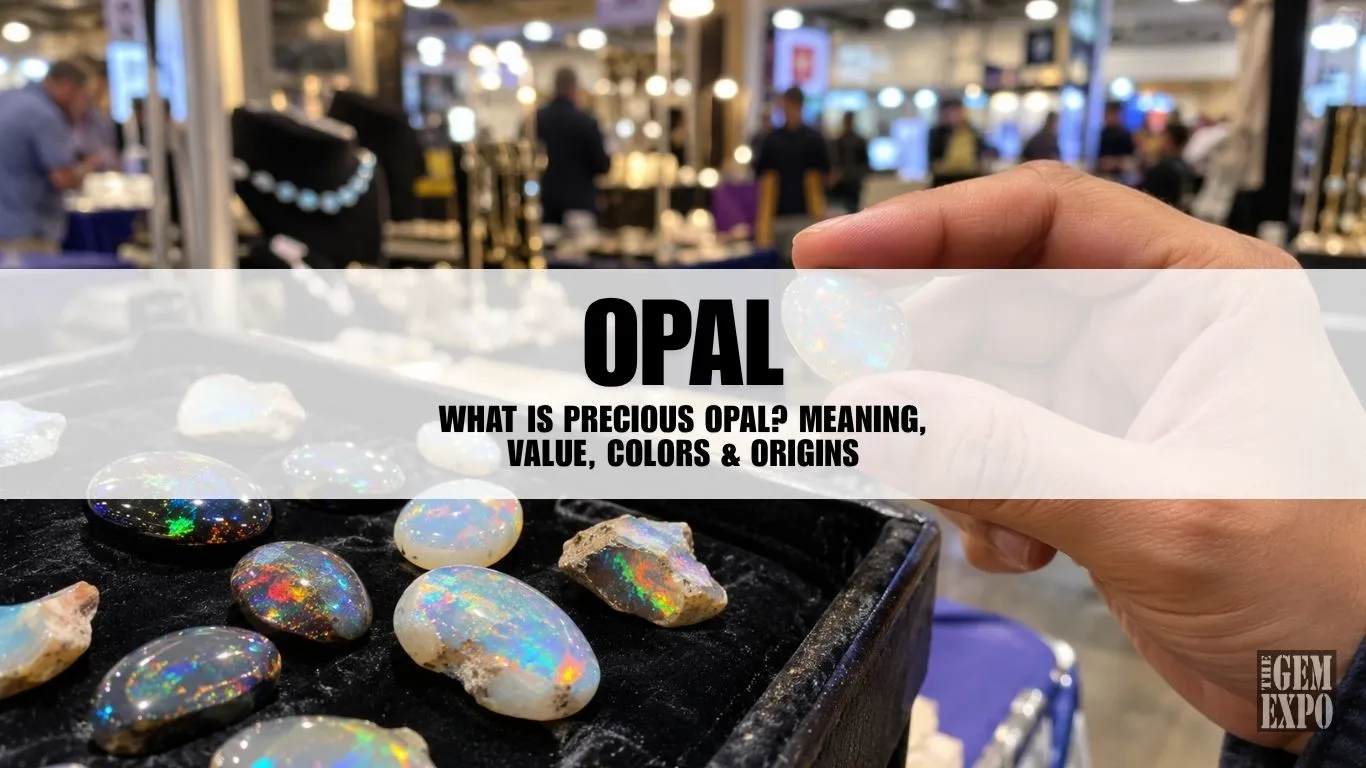

A woman once picked up a small grey stone at a gem show table, ready to set it back down as nothing special. Then she turned it under the light, and the stone burst into flashes of red, green and blue right there in her palm. That is the moment almost everyone remembers the first time they hold a genuine Precious Opal. It looks quiet one second and alive with colour the next, and that little bit of magic is exactly why this gemstone has been prized for thousands of years.
If you have ever wondered what makes this stone so different from an ordinary rock, or why some pieces cost far more than others, you are in the right place. This article walks through what a Precious Opal actually is, how it forms underground, the many colours it comes in, what it means as a birthstone, and how Canadian opal fits into the picture. If you would rather see one up close than just read about it, The Gem Expo brings dozens of opal and gemstone vendors together under one roof, so you can hold a piece before deciding to bring it home.
For more stone deep-dives like this one, our gemstone blog covers everything from crystal meanings to buying tips.
What Is Precious Opal? A Simple Explanation
So, what is opal, exactly? Opal is a mineraloid, which means it does not have the neat crystal structure that most gemstones have. Instead, it is made of tiny silica spheres packed together with water trapped between them. When those spheres line up in a regular pattern, light bends as it passes through and splits into a rainbow of colour. That effect is called play of colour, and it is the single feature that separates an ordinary opal stone from true Precious Opal.
Not every opal shows this effect. Common opal, sometimes called potch, is usually just one flat colour with no fire inside it. It is also often confused with other banded minerals such as agate, even though the two form through completely different processes. Only material that flashes colour when it moves earns the name precious, and this is one of the most common points of confusion for anyone buying their first opal gem.
How Is Opal Made? The Science Behind the Sparkle
Understanding how is opal made helps explain why good pieces are never cheap. The process starts when rainwater picks up dissolved silica as it travels through cracks in sedimentary rock. Over thousands, sometimes millions, of years, this silica-rich water settles into cavities and slowly hardens. Here is the process broken into simple stages:
- Water carries dissolved silica down through layers of rock.
- The silica settles into cracks, cavities, or old fossil spaces underground.
- Tiny silica spheres begin forming as the water slowly evaporates.
- If the spheres pack together evenly, play of colour is created; if not, only common opal forms.
- The material hardens fully into a finished opal crystal over a very long stretch of geological time.
This is quite different from organic gems such as amber, which forms from fossilized tree resin rather than mineral deposition. Because even packing is rare, only a small percentage of all opal found worldwide qualifies as gem-grade, and that scarcity is part of why the market keeps circling back to a handful of dependable sources for genuine Precious Opal.
Types of Opal: From White Opal to Rare Black Opal
There is more variety here than most people expect, and each opal colour type carries its own price range and personality, though only stones with true play of colour count as Precious Opal.
| Opal Type | Typical Background | What Makes It Special |
|---|---|---|
| White opal | Pale, milky white opal color | Softer colour flashes, most widely available |
| Crystal opal | Clear to semi-transparent | Colour appears to float inside the stone |
| Black opal | Dark grey to true black opal rock | Strongest contrast, the most valuable of all opal varieties |
| Boulder opal | Thin opal layer on ironstone | Natural, undivided backing, unique patterns |
| Fire opal | Orange, red or yellow base | Prized for warm tone rather than play of colour |
| Pink opal | Soft pink opal colour, usually common opal | Popular in jewellery and healing circles |
| Hyalite opal | Colourless, glassy | Can glow green under UV light |
Among these, black opal gemstone pieces consistently sell for the highest prices, since dark backgrounds make every flash of colour pop. A well-cut black opal stone from a strong source can be worth more per carat than a diamond of similar size. If you enjoy stones that shift colour in changing light, labradorite is another collector favourite, though its glow works through a different optical effect entirely. Blue opal and green opal pieces sit in the middle of the market, valued for calm, steady colour play, while white opal remains the easiest entry point for a first purchase.
Opal Meaning, Birthstone and Wellness Uses
Beyond the science, opal meaning runs deep in folklore and modern practice alike. Ancient cultures believed the stone held the powers of every gem it seemed to mirror, since its play of colour could flash red like a ruby one moment and green like an emerald the next. That reputation is part of why opal stone meaning still carries an air of mystery today.
In birthstone traditions, opal is what birthstone people born in October look to, making it the accepted opal birthstone month. Many also turn to opal application in wellness routines, using the stone during meditation or wearing it close to the body as part of an opal wellness practice tied to emotional balance and creativity. Crystal collectors who already work with grounding stones like black obsidian sometimes add opal separately, since its energy is linked to water and intuition rather than grounding. Some traditions connect opal by element to water for this reason. Whether or not that side interests you, opal significance as a symbol of hope and inspiration has stayed consistent for centuries, cementing Precious Opal as far more than just a pretty stone.
What Gives Precious Opal Its Value?
Four factors decide what any given Precious Opal is worth: body tone, brightness of the play of colour, pattern, and origin. A dark body tone with bold, broad colour flashes will always outprice a pale stone with faint sparks, even when both pieces are the same size. According to mineral reference sources such as Mindat’s gemmological database, the internal structure responsible for this effect is an orderly, three-dimensional grid of silica spheres, and even a slight irregularity in that grid can turn a would-be gem into plain common opal.
Origin matters too. Roughly ninety-five percent of the world’s supply still comes from Australia, but Ethiopian material has grown fast in popularity since the 1990s for its bright, affordable colour, and dedicated Ethiopian opal vendors now supply collectors well beyond Africa.
Canadian Opal: A Hidden Gem in Our Own Backyard
Most people are surprised to learn Canada has its own opal story. British Columbia is home to the country’s only commercially recognized opal deposit, found in the Okanagan region, where canadian opal has been mined since the late 1990s. It shows the same play of colour prized in Australian material, though production remains small compared to major world sources. For collectors who like a story behind their stone, a piece of canadian opal makes a genuinely local souvenir rather than an import, and meeting Canadian opal specialists at a show is one of the easiest ways to see the difference for yourself.
Moonstone vs Opal: What’s the Difference?
Because both stones shimmer, people often ask about moonstone vs opal and assume the two are related. They are not. Moonstone gets its glow, called adularescence, from layers of feldspar reflecting light in a single soft sheen, usually blue or white. It will never split into a full rainbow the way genuine opal can, since it lacks the silica sphere structure that produces true play of colour. If a seller cannot explain which effect a stone shows, that is a fair sign to ask more questions before buying.
How to Choose and Care for Your Opal
Picking a good piece and keeping it safe does not need to be complicated. Follow these steps:
- Look at the stone from several angles under natural light to check how strong and even the play of colour is.
- Ask whether it is a solid opal, a doublet, or a triplet, since this changes both price and durability.
- Check the body tone, since darker stones such as black opal tend to hold value better over time.
- Store opal jewellery away from extreme heat or dry air, since the water content inside can lead to tiny cracks if the stone dries out too fast.
- Clean it gently with a soft cloth and lukewarm water only, and avoid ultrasonic cleaners.
Established Toronto dealers such as Skyjems are used to walking first-time buyers through these questions in person, which is often easier than judging photos online. Opal is softer than many other gemstones, so a protective setting such as a bezel is usually recommended for rings worn daily. This one habit prevents most of the chips and cracks that damage otherwise beautiful pieces.
FAQs
How can you tell if a precious opal is real or synthetic?
Natural precious opal shows uneven, patchy colour patterns with a slightly grainy structure under magnification, while synthetic opal often displays a repeating, columnar "chicken wire" or "lizard skin" pattern that looks too uniform. Genuine stones also feel cooler and heavier for their size. When in doubt, ask for a gemological report or buy from an established dealer who can confirm origin and authenticity in writing.
Is it safe to wear precious opal in water or the shower?
Brief contact with water will not damage a solid precious opal, since it already contains a natural water content. However, prolonged soaking, sudden temperature changes, or harsh chemicals like chlorine and soap can weaken the stone over time and cause fine cracks called crazing. It is safer to remove opal jewellery before swimming, showering, or cleaning to keep the stone stable for years.
How much does precious opal cost per carat?
Prices vary enormously based on colour, brightness, and origin. Common white or crystal opal can start around 10 to 100 dollars per carat, while high-grade black opal with strong red flashes can reach several thousand dollars per carat. Size, pattern rarity, and whether the stone is solid, a doublet, or a triplet all shift the final price significantly.
Is precious opal a good investment?
Top-grade black and boulder opals from limited sources have historically held or increased in value, since supply keeps shrinking while collector demand grows. That said, opal is softer and more fragile than stones like sapphire, so resale value depends heavily on condition. Treat it as a collectible you enjoy first, with investment potential as a secondary benefit rather than a guarantee.
What is the rarest colour pattern in precious opal?
Red flash on a black body tone is widely considered the rarest and most valuable combination, since red sits at the far end of the visible light spectrum and is the hardest colour for the silica structure to produce consistently. Stones showing a full, even spread of red across a dark background are uncommon enough that they command premium prices at auction and in private sales.
See Precious Opal in Person at The Gem Expo
Reading about a stone only goes so far, and photos never quite capture how a Precious Opal actually moves in the light. The Gem Expo brings this experience to Toronto three times a year, next at the Hyatt Regency from November 27 to 29, where dedicated vendors display everything from raw opal to finished jewellery. Browsing the full gemstone vendor directory ahead of time can help you plan which booths to visit first.
Whether you are drawn in by the science, the history, or simply the way a good stone catches the light, there is no substitute for seeing a real Precious Opal turn in your own hand. Grab a ticket, find your favourite colour flash, and start a collection that tells its own story.