


A woman walked into The Gem Expo last spring holding a small pink stone with black streaks running through it like tiny rivers. She had found it in her late mother’s jewellery box and had no idea what it was called or why her mother had kept it so close. When one of our vendors told her it was a Rhodonite Crystal, her eyes filled up. She said it finally made sense why she had always felt calmer holding it.
That is the kind of story heard often at The Gem Expo, Toronto’s own gem, mineral and crystal show. People do not just want a pretty stone, they want to understand what they are holding and why it seems to matter so much. For more stone breakdowns written this same way, our Gemstone Blog covers dozens of crystals in plain, everyday language.
If you would like to see natural rhodonite up close before reading further, you are welcome to explore The Gem Expo and meet vendors who work with this stone regularly.
What Is a Rhodonite Crystal?
So, is rhodonite a mineral, or just a pretty rock people call a crystal for marketing reasons? Technically, yes, it is a real mineral. Mineral rhodonite is classified as a manganese inosilicate, which is simply a science way of saying it is built from manganese and silica bonded together in a chain-like structure. It was first identified in the Ural Mountains of Russia in the early 1800s, and its name comes from the Greek word for rose, because of its pink colour.
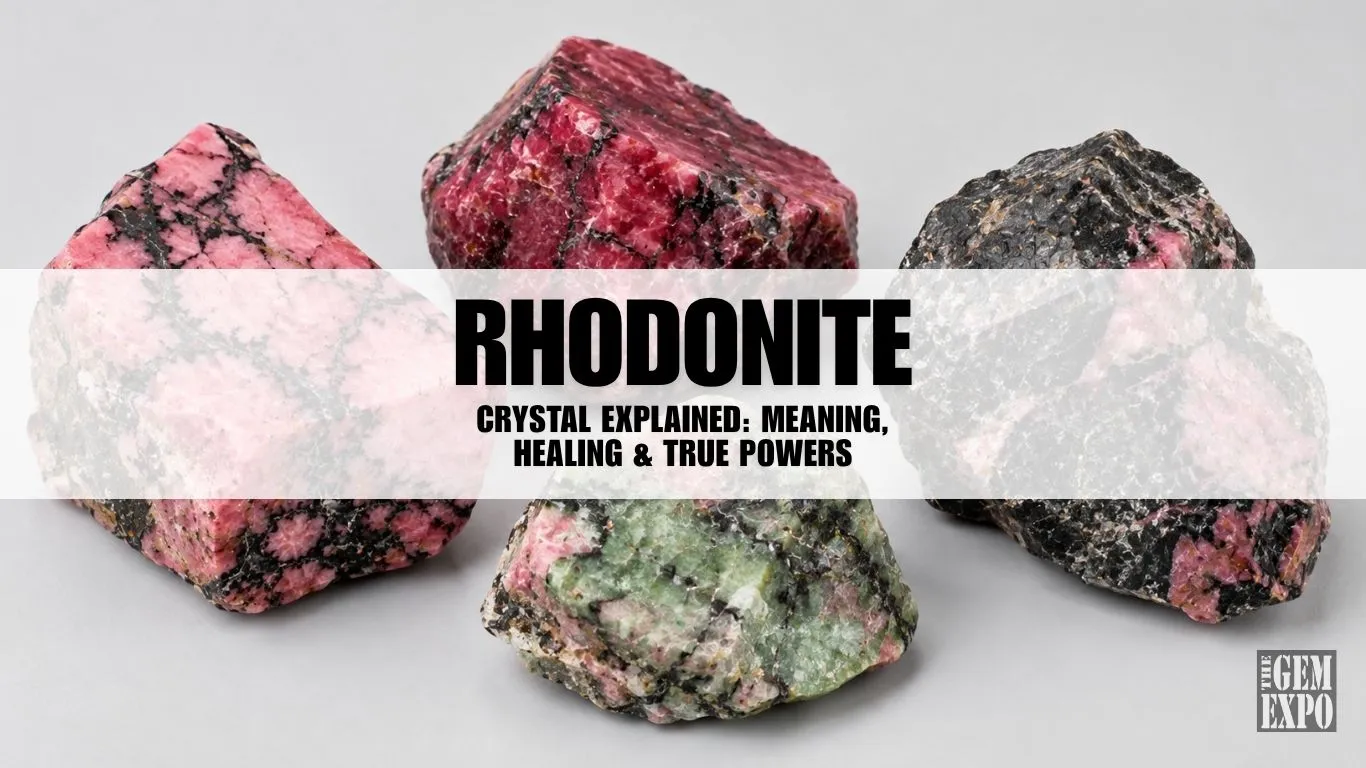
A Rhodonite Crystal forms in metamorphic rock, usually where manganese deposits have been squeezed and heated over millions of years. This is why no two pieces look exactly alike. Some pieces come out a soft blush pink, others show up as dark red rhodonite with heavy black veining, and a few rare specimens even lean toward green rhodonite when other minerals mix in during formation.
If you enjoy learning how pressure and heat shape a stone’s structure, our aragonite crystal breakdown walks through a similar process in a completely different mineral family.
Natural Rhodonite: Colour, Structure and Where It Comes From
Natural rhodonite is mined in several places around the world, including Russia, Sweden, Brazil, Madagascar and right here in Canada. Canadian rhodonite tends to come out in gentler pastel tones with pale green flecks, which is part of why it has become such a favourite among Canadian collectors. According to the mineral database Mindat, rhodonite sits at roughly 5.5 to 6.5 on the Mohs hardness scale, which makes it durable enough for jewellery but still soft enough that it needs a bit of care.
The colour differences are not random. Iron and other trace minerals decide whether a piece leans toward blush pink, dark red rhodonite, or the rarer green rhodonite variety. When people search for crystals rhodonite online, they are usually looking for pieces with strong contrast between the pink base and the black manganese oxide streaks, since that pattern is the easiest to recognize at a glance.
If pastel-toned Canadian stones interest you, our guide to moonstone crystals explores another gentle, protective stone that many people pair with rhodonite.
Rhodonite Spiritual Meaning
The rhodonite spiritual meaning almost always circles back to one word: rescue. Long before crystal shops existed, this stone was passed down in families as something given to a person going through heartbreak, grief or a hard transition. It is nicknamed the rescue stone because it is believed to pull people out of emotional shutdown and back into connection with others.
Beyond the rescue stone reputation, the rhodonite spiritual meaning also touches on forgiveness. Many practitioners use it during meditation when they are trying to let go of resentment, whether that resentment is aimed at someone else or at themselves. It is gentle rather than dramatic, which is part of why so many beginners choose a Rhodonite Crystal as their first emotional support stone.
Healing Properties of Rhodonite and Everyday Rhodonite Benefits
When people ask about the healing properties of rhodonite, they are really asking one simple question: what can this stone actually do day to day? The most commonly reported rhodonite benefits include easing anxious thoughts, supporting self-worth, and helping people process old emotional wounds without feeling overwhelmed by them.
It is worth being upfront here. None of these claims are backed by clinical research, and rhodonite should never replace therapy, medication or medical care. What can be said, based on generations of documented use, is that the healing properties of rhodonite are tied to its connection with the heart chakra. It is believed to open that energy centre gently, which is why it is often carried during difficult conversations or kept on a nightstand during emotionally heavy weeks.
Beyond emotional support, many collectors also mention physical rhodonite benefits, such as feeling more energized or noticing improved circulation while wearing it. These reports are anecdotal rather than scientific, but they come up often enough in conversations at The Gem Expo that they are worth mentioning.
If you would like to hold a few different pieces and feel the weight and texture for yourself, our vendors at The Gem Expo are always happy to walk you through the differences between specimens in person.
Black Rhodonite and Black Rhodonite Benefits
Black rhodonite is not actually rhodonite that lacks pink colouring. Instead, it usually refers to specimens where black manganese oxide has spread so heavily across the surface that the pink base is barely visible. This heavily marked black rhodonite is still a genuine Rhodonite Crystal, just one that leans darker due to natural oxidation over time.
People searching for black rhodonite benefits are usually looking for a stronger grounding effect. Because the darker material contains more manganese oxide, many practitioners treat it as a bridge between the emotional gentleness of pink rhodonite and the grounding intensity of stones like black onyx. It is often chosen by people who want emotional healing paired with a firmer, more protective feel.
Black rhodonite pieces also tend to cost less than the classic pink and black variety, which makes them an accessible entry point for anyone curious about black rhodonite benefits without committing to a premium specimen right away.
Rhodonite vs Rhodochrosite: What Is the Real Difference?
This is easily the most common mix-up in the gem world. Rhodonite vs rhodochrosite confusion happens because both stones share a similar pink colour family and both contain manganese. However, they are chemically and structurally different minerals, and telling them apart becomes easy once you know what to look for.
| Feature | Rhodonite | Rhodochrosite |
|---|---|---|
| Composition | Manganese silicate | Manganese carbonate |
| Hardness | 5.5 to 6.5 | 3.5 to 4 |
| Pattern | Pink with black streaks | Pink with white or cream bands |
| Common uses | Jewellery, carvings, specimens | Carvings and display pieces |
The biggest difference between rhodonite and rhodochrosite comes down to hardness and pattern. Rhodochrosite is noticeably softer and usually shows smooth banding rather than the jagged black streaks found in a typical Rhodonite Crystal. If a stone scratches easily and has soft, wavy bands, it is very likely rhodochrosite rather than rhodonite.
This is similar to how people confuse calcite formations with other carbonate minerals, since colour alone is rarely enough to identify a stone correctly. So the next time rhodonite vs rhodochrosite comes up, remember that the real difference between rhodonite and rhodochrosite is not really about colour. It is about hardness, structure and the way each stone forms underground.
How to Cleanse Rhodonite: A Simple Step by Step Guide
Knowing how to cleanse rhodonite properly matters, because this stone is softer than quartz and can be damaged by rough handling. Here is a simple, safe approach.
- Rinse gently under lukewarm water for a few seconds, avoiding hot water, which can cause fractures.
- Pat it dry immediately with a soft cloth rather than letting it air dry.
- Place it near a window for a few hours of natural sunlight, avoiding long direct exposure, which can fade the pink colour over time.
- Rest it near a piece of labradorite or selenite overnight to recharge without water at all.
- Store it separately from harder stones so it does not get scratched while sitting in a drawer or pouch.
Following these steps for how to cleanse rhodonite once or twice a month is usually enough to keep the colour vivid and the energy, as many collectors describe it, feeling fresh.
FAQs
Which zodiac signs pair best with a Rhodonite Crystal?
Rhodonite is most often linked to Taurus, thanks to its grounded, patient energy, and also resonates with Gemini and Scorpio for emotional balance and forgiveness work. It is connected to the planet Venus, which governs love and relational harmony. This makes it a popular pick for anyone working on self-worth, steady relationships, or letting go of resentment.
Is it safe to sleep with a Rhodonite Crystal under your pillow?
Yes, many people keep a Rhodonite Crystal on their nightstand or under their pillow, especially during emotionally heavy or overstimulating periods. It is believed to support restful sleep by calming the heart chakra before bed. A simple practice is holding it over your chest for a few deep breaths before settling in for the night.
Can a Rhodonite Crystal be safely combined with other crystals?
Yes, rhodonite pairs well with rose quartz, clear quartz and amethyst to amplify emotional healing, and with selenite or clear quartz for cleansing and recharging. Darker, root-chakra-leaning pieces are sometimes grouped with grounding stones. There is no strict rule here, so pairing usually comes down to personal intention rather than fixed guidelines.
Does a Rhodonite Crystal have an official birthstone or birth month?
No, rhodonite is not an official birthstone for any month under modern birthstone lists. It does not carry the same formal recognition as stones like garnet or amethyst. That said, some practitioners informally treat it as a companion stone for Taurus season, given its Venus association, rather than a true calendar birthstone.
How can you tell if a Rhodonite Crystal is genuine before buying it?
A genuine Rhodonite Crystal has a glassy to pearly lustre, feels cool to the touch, and shows natural pink to red colouring with irregular black manganese veining rather than perfectly uniform patterns. Dyed or resin-filled imitations often look too evenly coloured. Buying from a known vendor or gem show, rather than an unverified online listing, is the safest way to confirm authenticity.
Why the Rhodonite Crystal Still Matters Today
In a world full of manufactured comfort objects, a Rhodonite Crystal stands out simply because it was shaped by real geological pressure over an unimaginable amount of time. That history is part of why so many people feel a genuine connection to it rather than treating it as just another accessory.
Whether someone is drawn to it for the rhodonite spiritual meaning, the reported rhodonite benefits, or simply the way a piece of dark red rhodonite catches the light, this stone continues to earn its place in collections across Canada and beyond. A well-chosen Rhodonite Crystal is not just decoration. It becomes a small, physical reminder to slow down and be a little kinder to yourself.
If this article made you curious enough to see rhodonite, black rhodonite and other natural specimens in person, The Gem Expo returns to the Hyatt Regency Toronto from November 27 to 29, 2026. You can check the full show hours and future dates before planning your visit.