

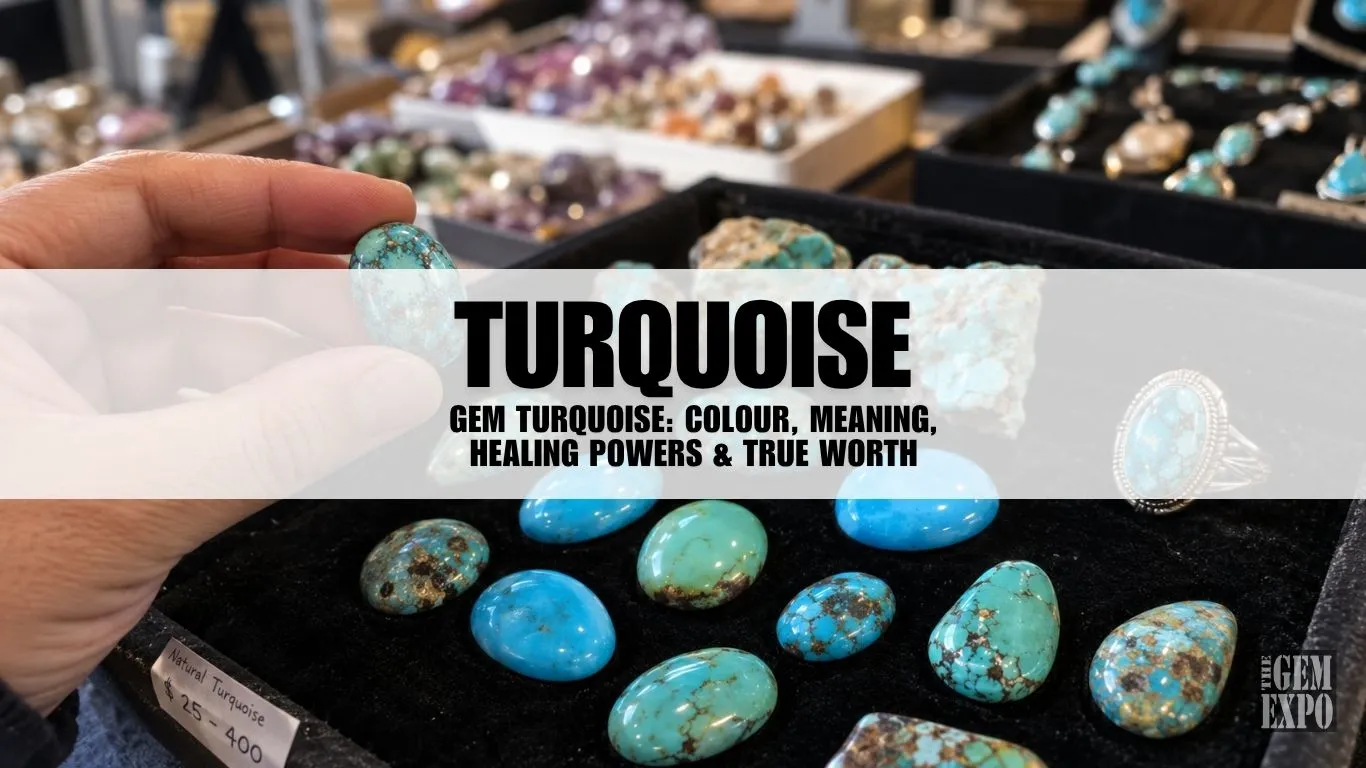

A woman once brought an old family ring to a table at a Toronto gem show and asked one simple question: “Is this real turquoise, or did someone just paint a bead blue?” The vendor held it to the light, looked at the faint spiderweb lines running through the stone, and smiled. That small moment is why so many people fall in love with gem turquoise in the first place. It is not just a pretty colour. It carries history, science, and a little bit of mystery in every piece.
This guide walks through everything worth knowing about gem turquoise, from its famous blue-green shades to its meaning, its healing reputation, and what actually makes one turquoise gemstone worth more than another. It is also cherished as a turquoise birthstone gift for December birthdays, which is one more reason so many families already own a piece without realizing its full backstory. If you have ever wondered why your grandmother’s turquoise ring looks nothing like the one in a jewellery store window, the answer is coming.
What Is Gem Turquoise, Really?
Gem turquoise is a naturally forming mineral made from copper and aluminum phosphate, and it has been prized for thousands of years by cultures across the world. Unlike a diamond or sapphire, turquoise gemstone material is opaque rather than clear, which gives it that soft, cloudy look many people recognize instantly. This gemstone turquoise is found in dry, copper-rich regions, which is why famous deposits sit in places like Arizona, Iran, and parts of China.
What makes gem turquoise stand apart from other blue stones is its texture. Genuine turquoise stones often carry a fine web pattern called a matrix, caused by the host rock trapped inside the mineral as it formed. That pattern is frequently treated as a small signature of authenticity, and it is often highlighted proudly within any well-curated gemstone jewellery collection rather than hidden away.
Turquoise Colour: Understanding Every Shade
The turquoise colour range surprises a lot of first-time buyers. Most people picture one single shade, but the colours of turquoise actually stretch from pale sky blue to deep green, depending on the exact copper and iron content in each stone.
A pure colour blue turquoise, with almost no green tint, is generally considered the most classic and desirable look, and many collectors specifically search for colour blue turquoise pieces because the tone photographs consistently under almost any lighting. Greener stones are just as natural, simply formed with slightly more iron in the mix rather than copper. Neither shade is more “real” than the other. Because gemstone turquoise reacts to trace minerals differently at each site, no two mines ever produce exactly the same tone.
| Turquoise Type | Typical Colour | Known For |
|---|---|---|
| Sleeping Beauty (Arizona) | Pure sky blue | Clean colour, little to no matrix |
| Kingman (Arizona) | Blue with dark matrix | Bold webbing patterns |
| Persian (Iran) | Robin’s-egg blue | Historic royal favourite |
| Chinese Turquoise | Blue to green | Wide colour range, budget friendly |
Turquoise Meaning and Its Ancient Significance
The turquoise meaning attached to this stone goes back further than most gemstones in regular use today. Ancient Egyptian tombs, Persian royal collections, and Indigenous jewellery across North America have all featured this stone for one shared reason: protection.
The significance of turquoise in many traditions centres on safe travel, honest communication, and calm energy. In South Asian culture, it is often known as the feroza gemstone, a name still used by many families passing pieces down through generations. Whether called feroza gemstone or simply turquoise, the underlying belief has stayed remarkably consistent across continents, and the significance of turquoise in bridal jewellery from Persia to the American Southwest shows just how far that reputation has travelled.
Turquoise Crystal Meaning and Healing Powers
In modern crystal circles, the turquoise crystal meaning is usually tied to the throat chakra, the energy point linked to speaking clearly and expressing true feelings without fear. This throat chakra connection is shared by only a few stones, and angelite’s healing powers are one of the closer comparisons worth reading about. People who work with a turquoise crystal often describe it as calming rather than energizing, which is one reason it is popular for daily wear instead of occasional ritual use.
The turquoise gem meaning most commonly reported by practitioners includes emotional balance, stress relief, and a sense of grounded confidence, a combination that pairs naturally with peridot’s renewal energy for anyone building a small healing collection. It is worth being honest here: these beliefs come from tradition and personal experience, not clinical science, and should be treated that way rather than as medical advice. Understanding turquoise gem meaning this way helps buyers see past the price tag and appreciate what they are actually holding.
This stone also holds a place as a turquoise birthstone, officially recognized as one of the birthstones for December. Anyone born in that month has likely received a turquoise birthstone piece at some point, often without realizing its long history stretches back centuries.
Turquoise Rock Meaning: How Nature Builds It
Understanding the turquoise rock meaning starts underground. This mineral forms when water carrying copper seeps slowly through aluminum-rich rock over an extremely long period, leaving behind a hardened, porous deposit. The colours of turquoise depend heavily on the ratio of copper to iron trapped during that slow process, which is why a turquoise gemstone from one mine rarely matches a stone pulled from another site nearby. According to the Gemological Institute of America, turquoise ranks among the oldest gemstones known to have been mined and worn by early civilizations.
Because turquoise stones are relatively soft compared to stones like sapphire, they absorb oils and body chemistry over years of wear, which slowly deepens their colour. This is one reason older pieces, including many turquoise rings, look richer than freshly mined material. For anyone who enjoys learning how rhodonite crystal forms through a similarly slow mineral process, turquoise offers a comparable geological story worth exploring further.
How to Spot Genuine Turquoise Stones
Telling real turquoise stones apart from dyed imitations is easier once you know what to check.
- Look closely at the matrix. Natural webbing is irregular, while fake patterns often repeat too perfectly.
- Check the weight. Genuine stone feels denser than plastic or resin lookalikes of a similar size.
- Ask about origin. Reputable sellers will openly share where a stone was mined and whether it has been treated or stabilized.
- Test under light. Dyed imitations sometimes show colour pooling around cracks that real turquoise does not have.
- Compare with larimar or other soft blue stones side by side, since holding two similar minerals together often makes fakes easier to notice.
Turquoise Rings and Everyday Jewellery Styling
A well-chosen turquoise ring remains one of the most popular ways people wear this stone, though turquoise rings also show up often in earrings, pendants, and layered bracelets. Because the stone pairs naturally with silver, most traditional pieces stick to that combination rather than gold, which can visually compete with the colour instead of complementing it. Some collectors also mix turquoise with softer tones, the same way a natural pearl piece is often layered with brighter stones for contrast.
For anyone building a wider collection, exploring gentler stones such as chrysoprase alongside turquoise creates a soft, nature-inspired palette that works well for everyday wear. Pairing pieces this way is also a favourite styling tip shared regularly by vendors at live shows.
Seeing these pieces in person, rather than through a screen, makes a real difference. The Gem Expo brings genuine vendors together under one roof, letting visitors compare colour, weight, and matrix patterns across dozens of pieces in a single afternoon.
What Determines the True Worth of Turquoise
Value comes down to a mix of factors rather than one single detail. Colour consistency, matrix pattern, hardness, and mine origin all play a role, and Persian-style stones with minimal matrix are traditionally priced higher than heavily webbed material. Treatment status matters too, since untreated, natural stone is typically valued well above stabilized or dyed material.
Buyers exploring their first piece are often encouraged to hold multiple stones side by side, the same way collectors compare bloodstone pieces before settling on one. Colour alone should never be the only factor, since two stones with nearly identical shade can differ significantly in density and durability.
FAQs
Is turquoise durable enough for everyday wear?
Turquoise sits at only 5 to 6 on the Mohs hardness scale, softer than sapphire or quartz, so it scratches more easily than harder stones. It can absolutely be worn daily with reasonable care, but it should come off before gym sessions, gardening, cleaning, or swimming. A ring or pendant set in protective silver bezels tends to hold up better over years of regular wear.
Can turquoise get wet or be worn in the shower?
No, turquoise should stay away from water, chlorine, and steam. It is a porous stone, meaning it absorbs liquids, soaps, and lotions like a sponge, which can dull its colour or cause surface damage over time. Removing turquoise jewellery before showering, swimming, or applying skincare products keeps the stone looking brighter for much longer.
Why does turquoise darken or change colour after wearing it for years?
This happens because turquoise is porous and gradually absorbs body oils, sweat, and skin chemistry through daily contact. Over months or years, this slowly deepens or darkens the original shade, a natural physical reaction rather than anything mystical. It is one reason older, well-worn turquoise pieces often look noticeably richer than newly mined stone.
What is the difference between turquoise and howlite?
Howlite is a white or grey mineral that is commonly dyed blue to imitate turquoise, and it is one of the most frequent substitutes sold to unsuspecting buyers. Genuine turquoise has natural colour variation and an irregular matrix, while dyed howlite often shows uneven colour pooling in its cracks and a chalkier, more uniform surface texture under close inspection.
How much does turquoise cost per carat?
Prices vary widely, from around 5 to 20 dollars per carat for common treated or lower-grade material, up to several hundred dollars per carat for untreated, high-grade Persian or Sleeping Beauty turquoise with even colour and minimal matrix. Origin, treatment status, and colour consistency are the biggest factors driving that gap in price.
See Gem Turquoise in Person at The Gem Expo
Reading about gem turquoise only goes so far. Holding it, turning it in natural light, and asking a vendor direct questions about origin is a different experience entirely. The Gem Expo returns to the Hyatt Regency Toronto, located at 370 King St West, from November 27 to 29, 2026, with genuine vendors bringing turquoise, feroza gemstone pieces, and dozens of other minerals for visitors to explore in person. Anyone curious about the colour, meaning, or true worth behind their own turquoise piece is welcome to come ask questions directly at the show.